


Product Description
by Ronald H. Nash (Author)
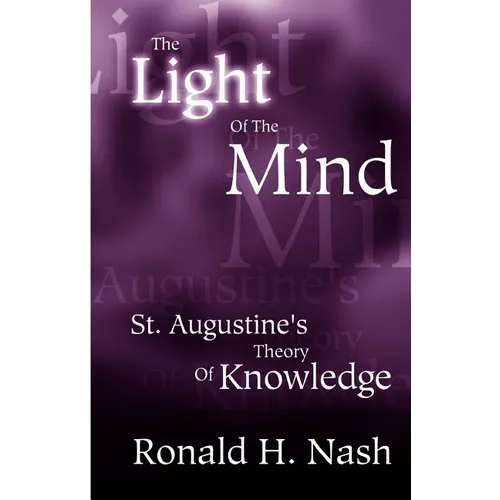
St. Augustine is not only the bridge that links ancient philosophy and early Christian theology with the thought of the Middle Ages, but one who, in his philosophy and especially in his epistemology, anticipated some of the most important ideas of Descartes and Malbranche, Berkeley and Kant. In this study of the central aspect of St. Augustine's thought, the author analyzes the various facets of his theory of knowledge and offers a new interpretation of his idea of divine illumination. St. Augustine's views on skepticism and truth, on faith and reason, and on sense perception and cogitation are first examined in order to show their relation to this theory of divine illumination as the ultimate source of truth for man. The proper understanding of the theory of illumination, of how man apprehends the divine ideas, is the most difficult problem in St. Augustine's epistemology, for he did not formulate any systematic theory of knowledge. Any account of the Augustinian epistemology, Mr. Nash believes, must resolve three paradoxes: how the intellect is both passive and active; how the forms are distinct from - and not distinct from - the human mind; and how man's mind is and is not the light that makes knowledge possible. In explaining the nature of divine illumination, Nash discusses four interpretations that have been advanced; the Thomist (which he rejects as not faithful to St. Augustine's general philosophy), the Franciscan, the Formalist, and the Ontologist. He argues here for a modified Ontologist view. In his synthesis of Christian theology and Neoplatonic philosophy, St. Augustine held that all creation partakes of truth in varying degrees, that man as the highest part of creation, created in God's image and thus sharing to some degree the divine nature, is able to know truth through the divine light and the light of his own mind. In attempting to find an answer to the perennial problem of knowledge, St. Augustine, Nash suggests, was struggling to find a theory that would combine the benefits of conceptualism and realism, and his answer was more modern than many have given him credit for. Ronald Nash is widely regarded as one of the premier evangelical philosophers in the world. He is professor of philosophy at Southern Baptist Theological Seminary in Louisville, Kentucky. He has taught at a number of other colleges and seminaries, including Western Kentucky University and Reformed Theological Seminary. The author of more than 35 books on philosophy, theology and economics, Dr. Nash is in constant demand as a speaker throughout the world.



