


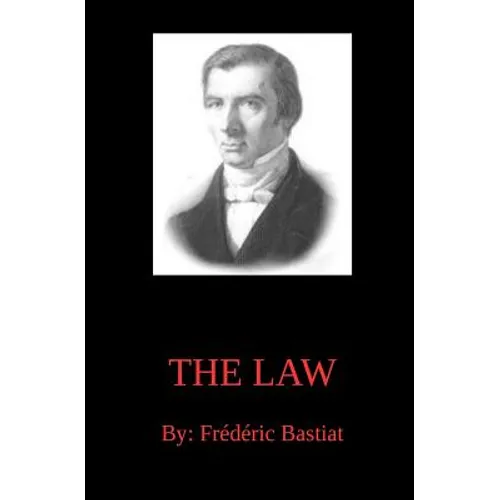
Product Description
by Frederic Bastiat (Author)
The Law was originally published in French in 1850 (this translation to English is from 1874) by Fr d ric Bastiat. It was written two years after the third French Revolution of 1848 and a few months before his death of tuberculosis at age 49. The essay was influenced by John Locke's Second Treatise on Government and in turn influenced Henry Hazlitt's Economics in One Lesson. It is the work for which Bastiat is most famous. Bastiat states that "each of us has a natural right - from God - to defend his person, his liberty, and his property." The State is a "substitution of a common force for individual forces" to defend this right. The law becomes perverted when it punishes one's right to self-defense in favor of another's acquired right to plunder. He defines two forms of plunder: "stupid greed and false philanthropy." Stupid greed is "protective tariffs, subsidies, guaranteed profits" and false philanthropy is "guaranteed jobs, relief and welfare schemes, public education, progressive taxation, free credit, and public works." Monopolism and Socialism are legalized plunder which Bastiat emphasizes is legal but not legitimate. Justice has precise limits but philanthropy is limitless and government can grow endlessly when that becomes its function. The resulting statism is "based on this triple hypothesis: the total inertness of mankind, the omnipotence of the law, and the infallibility of the legislator." The relationship between the public and the legislator becomes "like the clay to the potter." Bastiat says, "I do not dispute their right to invent social combinations, to advertise them, to advocate them, and to try them upon themselves, at their own expense and risk. But I do dispute their right to impose these plans upon us by law-by force-and to compel us to pay for them with our taxes."
Author Biography
Frédéric Bastiat was born in Bayonne, Aquitaine, France. When he was nine years old, he was orphaned and became a ward of his father's parents. At age seventeen he left school to become more involved with his family's business as an exporter. Economist Thomas DiLorenzo suggests that this family business experience was crucial to Bastiat's later work because it allowed young Frédéric to acquire first-hand knowledge of some of the effects of trade regulations on the market. Sheldon Richman notes that "he came of age during the Napoleonic wars, with their extensive government intervention in economic affairs." When Bastiat was twenty-five, his grandfather and benefactor died, leaving the young man the family estate and providing him with the means to further his own theoretical inquiries. His areas of intellectual interest were diverse, including "philosophy, history, politics, religion, travel, poetry, political economy, [and] biography." His public career as an economist began only in 1844, and was cut short by his untimely death in 1850. Bastiat had contracted tuberculosis, probably during his tours throughout France to promote his ideas, and that illness eventually prevented him from making further speeches (particularly at the legislative assembly to which he was elected in 1848 and 1849) and took his life. Bastiat died in Rome on 24 December 1850.



