


Product Description
by Charles River (Author)
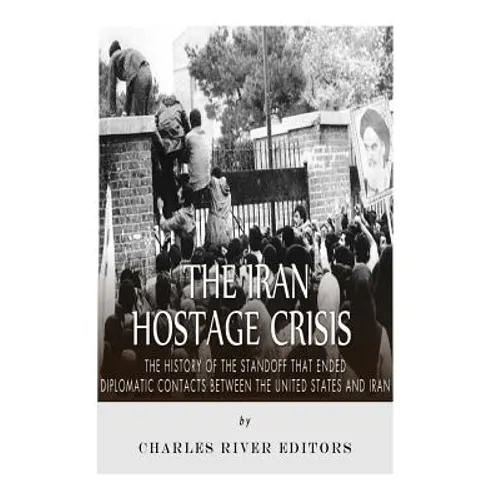
*Includes pictures *Includes accounts of the crisis by hostages, politicians, and Iranian students *Includes online resources and a bibliography for further reading *Includes a table of contents "Carter's predecessor, whom he says he emulates -- Harry Truman -- would have landed the Marines and offered to cripple Iran's economic base. These Iranians have committed an act of war against the United States and all Carter wants to do at the moment is talk. It is time to speak with the power and the might of a first rate country instead of the wishy-washy language of diplomatic compromise." Daniel A. Darlington's Letter to the Editor, Denver Post On February 1, 1979, amid great fanfare, exiled cleric Ayatollah Ruhollah Khomeini landed in Tehran. The return of the leader of the revolution to his home country was one of the final markers of the Iranian Revolution, a national phenomenon that had global implications. The Iranian Revolution of 1979 has been described as an epochal event, called the peak of 20th century Islamic revivalism and revitalization, and analyzed as the one key incident that continues to impact politics across Iran, the Middle East, and the even the world as a whole. As a phenomenon that led to the creation of the first modern Islamic Republic in the world, the revolution marked the victory of Islam over secular politics, and Iran quickly became the aspiring model for Islamic fundamentalists and revivalists across the globe, regardless of nationality, culture, or religious sect. When Ayatollah Khomeini was declared ruler in December 1979 and the judicial system originally modeled on that of the West was swiftly replaced by one purely based on Islamic law, much of the world was in shock that such a religiously driven revolution could succeed so quickly, especially when it had such sweeping consequences beyond the realm of religion. Furthermore, while the focus of the revolution was primarily about Islam, the revolution was also colored by disdain for the West, distaste for autocracy, and a yearning for religious and cultural identity. This point was driven home on November 4, 1979 when Iranians stormed the U.S. embassy and took dozens of Americans hostage, sparking a crisis that would last for the rest of President Jimmy Carter's term. A few Americans escaped the embassy and hid in Tehran before being extracted (a mission that was recently adapted into the movie Argo), but for nearly 450 days, the crisis remained at the forefront of America's daily life, and aside from an embarrassing failed rescue mission, the administration seemed uncertain over how to approach the crisis and protect the American hostages. Eventually, all of the hostages were freed on the day Ronald Reagan was inaugurated as president in 1981, but the Iran hostage crisis had far reaching ramifications that have lasted to this day. Most notably, formal diplomatic contact between the United States and Iran ended, and no American embassy is open in that country nearly 35 years later. For anyone born during the 1960s, the Iran Hostage Crisis marked a change in American identity both as people and a nation. Those born in earlier decades had little to no understanding of radical Islam, and those born later could not conceive of a world without it. Some would say that the crisis was ultimately a good thing, in that it ushered Ronald Reagan into the White House and thus led to the fall of Communism, while others would say that it was a harbinger of doom, a demonstration that even as one geopolitical foe declined, another was on the rise. Some say America was singled out because it was seen as too strong, others because it was seen as too weak. The bottom line is that, while no one knows what might have been done to prevent it, everyone has an idea about how it might have been ended sooner.



