


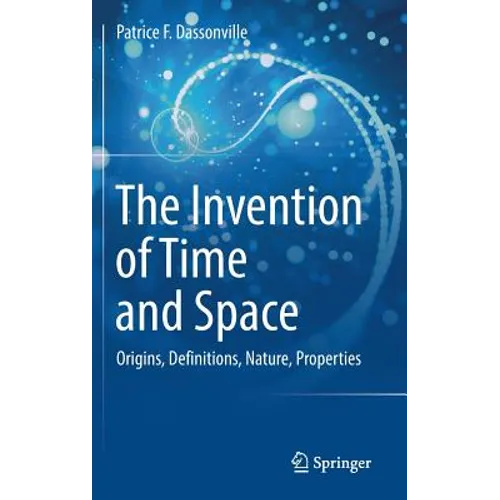
Product Description
by Patrice F. Dassonville (Author)
This investigation of time and space is motivated by gaps in our current understanding: by the lack of definitions, by our failure to appreciate the nature of these entities, by our inability to pin down their properties.
The author's approach is based on two key ideas: The first idea is to seek the geo-historical origins of time and space concepts. A thorough investigation of a diversified archaeological corpus, allows him to draft coherent definitions; it furthermore gives clues as to whether time and space were discovered or invented. The second idea is to define the units before trying to define space and time.
The results presented here are unexpected: Time and space were not discovered in nature, but they were invented; time is not a phenomenon and space has no materiality; they are only concepts. This runs contrary to the opinion of most scientific and the philosophical authorities, although one would seek in vain for a theoretical validation of the conventional position. This book will provide much food for thought for philosophers and scientists, as well as interested general readers.
Back Jacket
This investigation of time and space is motivated by gaps in our current understanding: by the lack of definitions, by our failure to appreciate the nature of these entities, by our inability to pin down their properties.
The author's approach is based on two key ideas: The first idea is to seek the geo-historical origins of time and space concepts. A thorough investigation of a diversified archaeological corpus, allows him to draft coherent definitions; it furthermore gives clues as to whether time and space were discovered or invented. The second idea is to define the units before trying to define space and time.
The results presented here are unexpected: Time and space were not discovered in nature, but they were invented; time is not a phenomenon and space has no materiality; they are only concepts. This runs contrary to the opinion of most scientific and the philosophical authorities, although one would seek in vain for a theoretical validation of the conventional position. This book will provide much food for thought for philosophers and scientists, as well as interested general readers.
Author Biography
Patrice Dassonville has a wide knowledge ranging from theoretical physics to business administration; he also has experience in teaching and in industrial engineering, and has worked in the USA and in Africa, including a crossing of the Sahara in 1973. His has a deep interest in philosophy, art, archaeology and ethnography. These broad interests helped him in realizing this book, for which interdisciplinarity plays a foremost role.



