Product Description
by Reyhan Sabri (Author)
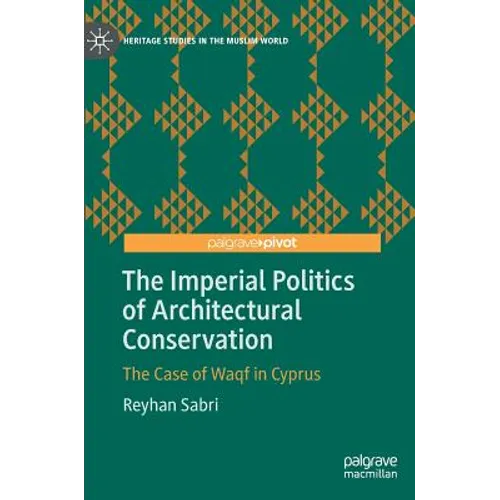
This book documents the changing role of the Islamic Waqf institution in Cyprus and the conservation of Waqf heritage buildings of Ottoman and Western origins. Previously ignored archives of documents detailing the conservation of Waqf buildings during Ottoman and British rule allow a fine-grained analysis of the colonial introduction of Western approaches to heritage conservation. Colonial rule saw major legislative and administrative changes to the originally autonomous Ottoman Waqf institution, which had already been subject to reforms under the Ottoman regime. Under British rule, Western heritage concepts and modern architectural conservation discourses became the core conservation principles in Cyprus. Earlier centralisation attempts during the Ottoman Tanzimat (1831-1876), and the procedural, technical, and political reconfigurations during the British colonial era in Cyprus (1878-1960), were key factors of the transformation of the Waqf's traditional building upkeep system. These imperial interventions, their orientalist mindset, and the rise of nationalism, finally led to the erosion of Waqf in Cyprus as a non-Western and sustainable form of building conservation. This study reveals how the Western approach, the forms of expertise it privileges, and pragmatic diversions from this practice for political purposes, were useful in neutralizing the legitimacy of local practices, except in cases where opportunistic 'recognition' of their utility played a role in inter-communal, colonial, nationalist, and inter-imperial politics.
Back Jacket
This book documents the changing role of the Islamic Waqf institution in Cyprus and the conservation of Waqf heritage buildings of Ottoman and Western origins. Previously ignored archives of documents detailing the conservation of Waqf buildings during Ottoman and British rule allow a fine-grained analysis of the colonial introduction of Western approaches to heritage conservation. Colonial rule saw major legislative and administrative changes to the originally autonomous Ottoman Waqf institution, which had already been subject to reforms under the Ottoman regime. Under British rule, Western heritage concepts and modern architectural conservation discourses became the core conservation principles in Cyprus. Earlier centralisation attempts during the Ottoman Tanzimat (1831-1876), and the procedural, technical, and political reconfigurations during the British colonial era in Cyprus (1878-1960), were key factors of the transformation of the Waqf's traditional building upkeep system. These imperial interventions, their orientalist mindset, and the rise of nationalism, finally led to the erosion of Waqf in Cyprus as a non-Western and sustainable form of building conservation. This study reveals how the Western approach, the forms of expertise it privileges, and pragmatic diversions from this practice for political purposes, were useful in neutralizing the legitimacy of local practices, except in cases where opportunistic 'recognition' of their utility played a role in inter-communal, colonial, nationalist, and inter-imperial politics.
Author Biography
Reyhan Sabri is an assistant professor in the Department of Architectural Engineering, University of Sharjah (UAE), where she teaches courses in the field of architectural history and theory. Her research interests are broadly related to the evolution of heritage management philosophies and practices in the colonial and post-colonial environments.