


Product Description
by James T. Bennett (Author)
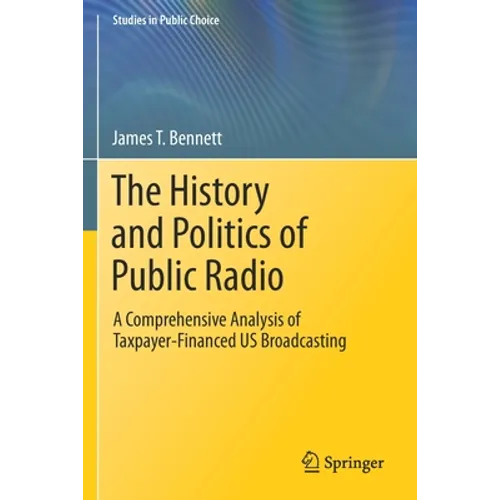
This book presents an absorbing study of how educational radio, which originated to broadcast weather forecasts to farmers, has become what the Pew Center calls the most trusted source of news for American liberals and a regular in the rogue's gallery of election-year conservative targets.The Nielsen Company reported in late 2019 that 272 million Americans listen to "traditional radio" each week, a number exceeding those who watch television, use a smartphone, or access the Internet. Yet almost from the start, radio has also been flayed as a noise box of inanity, a transmitter of low-brow entertainment, an instrument of cultural degradation promoting vapid popular music, and a medium whose ultimate purpose is to convince listeners to purchase the goods and services incessantly hawked by the advertisers who underwrite the programs and allegedly dictate content. At the same time, an alternative conception of radio existed as a vehicle for education and for cultural and intellectual (and even political) enlightenment. Most proponents of this perspective disdained advertising revenue and sought subsidies from foundations, wealthy patrons, or varying levels of government.The long, winding road of educational radio led eventually to the creation of National Public Radio (NPR), a fixture on the left of the dial that can be seen as either the consummation or corruption of the educational radio movement. Prized by many liberals, especially affluent whites, and disparaged by many conservatives, NPR has become a potent symbol of the political polarization and cultural chasm that now characterizes the American conversation.
Back Jacket
This book presents an absorbing study of how educational radio, which originated to broadcast weather forecasts to farmers, has become what the Pew Center calls the most trusted source of news for American liberals and a regular in the rogue's gallery of election-year conservative targets.The Nielsen Company reported in late 2019 that 272 million Americans listen to "traditional radio" each week, a number exceeding those who watch television, use a smartphone, or access the Internet. Yet almost from the start, radio has also been flayed as a noise box of inanity, a transmitter of low-brow entertainment, an instrument of cultural degradation promoting vapid popular music, and a medium whose ultimate purpose is to convince listeners to purchase the goods and services incessantly hawked by the advertisers who underwrite the programs and allegedly dictate content. At the same time, an alternative conception of radio existed as a vehicle for education and for cultural and intellectual (and even political) enlightenment. Most proponents of this perspective disdained advertising revenue and sought subsidies from foundations, wealthy patrons, or varying levels of government.The long, winding road of educational radio led eventually to the creation of National Public Radio (NPR), a fixture on the left of the dial that can be seen as either the consummation or corruption of the educational radio movement. Prized by many liberals, especially affluent whites, and disparaged by many conservatives, NPR has become a potent symbol of the political polarization and cultural chasm that now characterizes the American conversation.
Author Biography
James T. Bennett holds the William P. Snavely Professorship in Political Economy and Public Policy at George Mason University (USA) and is a prolific author in the fields of public policy and public choice. In addition to numerous articles in academic journals, he has authored more than two dozen books on various topics.



