


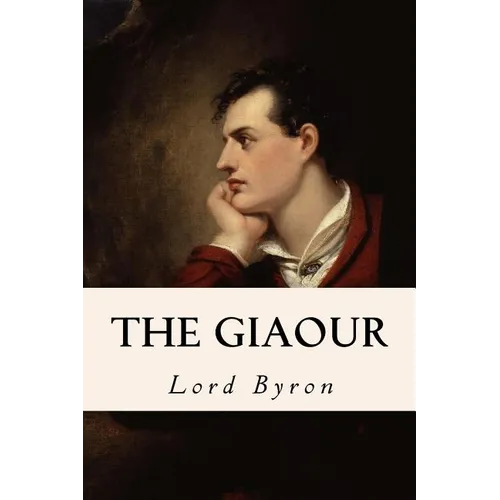
Product Description
by George Gordon Byron 1788- (Author)
"Giaour" is an offensive Turkish word for infidel or non-believer, and is similar to the Arabic word "kafir". The story is subtitled "A Fragment of a Turkish Tale", and is Byron's only fragmentary narrative poem. Lord Byron designed the story with three narrators giving their individual point of view about the series of events. Byron was inspired to write the poem during his Grand Tour during 1810 and 1811, which he undertook with his friend John Cam Hobhouse. While in Athens, he became aware of the Turkish custom of throwing a woman found guilty of adultery into the sea wrapped in a sack. "Giaour" (Turkish: G vur) is an offensive Turkish word for infidel or non-believer, and is similar to the Arabic word "kafir". The story is subtitled "A Fragment of a Turkish Tale", and is Byron's only fragmentary narrative poem. Byron designed the story with three narrators giving their individual point of view about the series of events. The main story is of Leila, a member of her master Hassan's harem, who loves the giaour and is killed by being drowned in the sea by Hassan. In revenge, the giaour kills him and then enters a monastery due to his remorse. The design of the story allows for contrast between Christian and Muslim perceptions of love, death and the afterlife. The poem was written after Byron had become famous overnight after the publication of the first two cantos of Childe Harold's Pilgrimage and reflects his disenchantment with fame. It also reflects the gloom, remorse and lust of two illicit love affairs, one with his half-sister Augusta Leigh and the other with Lady Frances Webster. The earliest version of the poem was written between September 1812 and March 1813, and a version of 700 lines published in June 1813. Several more editions were published before the end of 1813, each longer than the last. The last edition contains 1300 lines, almost twice as many as the version first published. The Giaour proved to be very popular with several editions published in the first year. By 1815, 14 editions had been published when it was included in his first collected edition. Its runaway success led Byron to publish three more "Turkish tales" in the next couple of years: "The Bride of Abydos" in 1813, "The Corsair" in 1814 and "Lara". Each of these poems proved to be very popular, with "The Corsair" selling 10,000 copies in its first day of publication. These tales led to the public perception of the Byronic hero. The Giaour illustrates the idea of Orientalism with its characters. Some critics consider Leila as a personification of Greece, for the sake of which there was a war between the Ottoman Empire and Russia.