


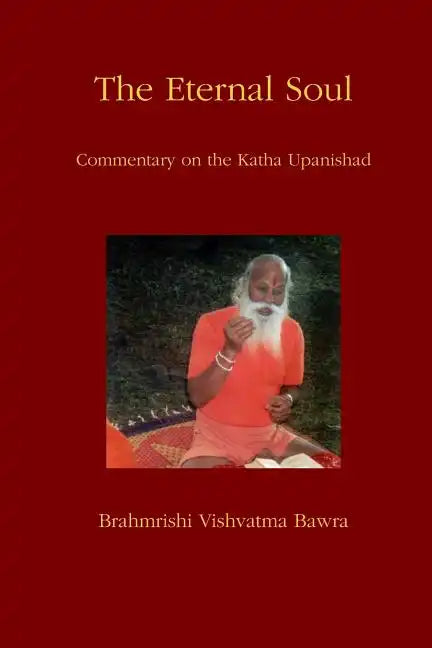
Product Description
by William F. Milcetich (Editor), Brahmrishi Vishvatma Bawra (Author)
When death is near, we seek to understand life. This is the premise of the Katha Upanishad and the inspired commentary of Swami Bawra. This commentary on the Katha is a great sequel to Swami Bawra's "Kapil's Samkhya Patanjali's Yoga" where the rational basis of inner connection with the source of life is developed in full detail.
Author Biography
Brahmrishi Vishvatma Bawra (1934-2002) is the founder of the International Brahmrishi Mission. He was born in a small village of India near Varanasi. As a child, he shied away from school and had no formal education. At the age of eighteen, he was enlightened by the touch of a great yogi of the Himalayas, Bhagvan Chandra Mauli, and remembered many previous lives spent with his guru. Under his guidance, Swami Bawra left his family to study in Ayodhya at the principal center of the Vaishnava Order. There, Swami Bawra studied according to the ancient system of scholarly teaching while performing higher spiritual practices under the guidance of his master, Chandra Mauli. By the grace of his master he received a distinctive memory of scripture and philosophical treatises. Thus he became a learned yogi of the Vaishnava Sanyasi Order. After a period of time, his master insisted that he return to society and help humanity by teaching the knowledge bestowed by Lord Krishna in the Bhagavad Gita. Swami Bawra hesitated to leave his spiritual ecstasy, but finally compromised with his master and followed his direction. Wearing only a loincloth, he begged alms, carried a small bag with Holy Scriptures, and traveled throughout India giving lectures on the Bhagavad Gita, Ramayana, Upanishads, Samkhya, Yoga, and Vedanta philosophies in the light of modern science. After twelve years of wandering, and at the request of his disciples, Swami Bawra agreed to establish a center for spiritual practice. The first center was inaugurated in 1965, and his mission eventually became an international organization with centers in Holland, England, Canada, and the United States. Swami Bawra also founded schools that included more than ten missionary schools for poor children in the villages of India. Swami Bawra's teaching emphasizes that the spiritual science of Brahma Vidya, knowledge of the source of life in Brahman, has two aspects, theory and practice. In the Upanishads and Bhagavad Gita the theory of this science is called Samkhya, and its practical aspect is called Yoga. On the basis of his own experiences, Swami Bawra taught a higher practice called Maha Yoga, the "great path" for realizing ultimate truth and finding freedom from suffering. His teachings are universal and not related with any caste, creed, color, country, community, gender, or sect.



