Product Description
by Mary O. Borg (Author), Paul M. Mason (Author), Stephen L. Shapiro (Author)
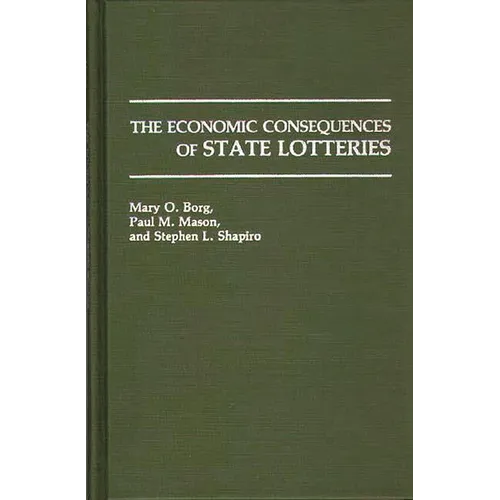
Since the modern wave of lotteries began over twenty-five years ago in New Hampshire, state-operated lotteries have become an area of tremendous growth for public sector financing. Gambling taxes of all kinds have been steadily increasing, and thirty-three states are now operating lotteries. In this work, Mary Borg, Paul Mason, and Stephen Shapiro examine the economic impact and consequences of state lotteries, focusing specifically on the efficiency and equity of state government revenue and expenditure policy.
The study begins with an overview of statistical information characterizing the nation's lotteries, and a review of the scholarly literature concerning lotteries and the economic evaluation of the lottery tax. A pair of chapters then explore the equity and efficiency of lotteries. The equity issues are addressed by considering the budgetary impact of the lottery in Illinois and Florida, while the efficiency issues focus on the six education-supporting lottery states, covering such topics as whether taxes are allocated to designated recipients and are efficiently administered. Subsequent chapters detail the effect of lottery taxes on other sources of state tax revenue, and the issue of whether money spent on lottery tickets comes at the expense of necessities or alternative expenditures. A final chapter offers policy prescriptions that could enhance efficiency and equity, as well as a discussion of whether lotteries should be discontinued. This volume will be an important resource for scholars and policy makers in economics, state and local government, and public administration, and a valuable addition to both public and academic libraries.Author Biography
MARY O. BORG is Associate Professor of Economics at the University of North Florida. She has published articles in National Tax Journal, Demography, The Journal of Economic Education, and International Journal of Industrial Organization.
PAUL M. MASON is Associate Professor of Economics at the University of North Florida. He has written articles for The American Economist, the Journal of Business and Economic Perspectives, and The National Tax Journal. STEPHEN L. SHAPIRO is Associate Professor of Economics at the University of North Florida. He has published articles in Public Finance Quarterly, The Journal of Economic Education, Applied Economics, and American Journal of Economics and Sociology.