Product Description
by Usmcr Colonel John a. Driscoll (Author)
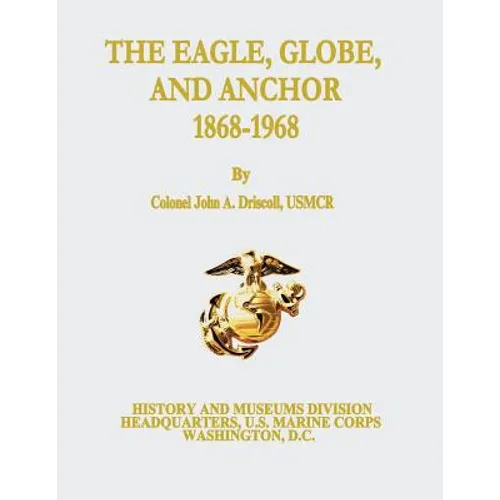
For the past century the Eagle, Globe, and Anchor emblem has been the symbol of the United States Marines. The purpose of this study is to explore and describe the development of the emblem and to provide students of Marine Corps history with a reference for its display on the diversity of uniforms worn by Marines since 1868. Evidence of emblems or ornaments ascribed to the Marine Corps can be found in correspondence as early as 1804 which refers to a brass eagle on a square plate being worn, while an octagonal brass plate embossed with an eagle, foul anchor, drums, flags, etc. was worn during the period of the War of 1812. Subsequent early devices include a gold plate with a gold eagle for wear with the officer's full-dress of 1821, while on 4 November 1834 an order prescribed a brass eagle "measuring from three to three and one-half inches from one extremity of the wing to the other", for wear on caps. During the early part of 1840, the undress hats of both officers and enlisted men displayed gold wreaths encircling the letters "U.S.M." A few months later, a blue cloth cap with black patent leather visor and "with a foul anchor of gold, in a gold wreath in front" was prescribed for officers not in full-dress uniform. In 1859 another ornament was adopted - a yellow metal huntinghorn, within which was placed a white metal letter ''M". For the full-dress cap, the bugle with "M" was mounted on a U.S. shield which was worn together with a laurel wreath. Both shield and wreath were of yellow metal. The ornament for the undress cap consisted of the yellow metal (or gold embroidered) bugle with the white metal (or silver) letter "M" while the ornament worn on the Officer's epaulette consisted of a solid silver bugle with a solid silver or plated "M". As the bugle of the 1859 ornament closely resembled the insignia of the U. S. Army infantry of that period, a step was taken in 1867 to provide the Marine Corps with a truly distinctive device. An order dated 2 May of that year directed that an ornament consisting of a "silver Western Hemisphere with gold continents and surmounted by a silver eagle" be worn on the officer's undress cap. This order was short-lived, however, as it was suddenly revoked on 5 June 1867. Finally, in November 1868, an "Eagle, Globe and Anchor" ornament was prescribed, which in spite of various changes in design, size and color, has survived the succeeding century unchanged in concept Although over the past 100 years this emblem has been displayed on such items as aircraft, belt plates, flags, guidons, helmet covers, official correspondence and publications, saddle cloths, tie clasps and utility clothing, this study deals only with the metal uniform ornament, its changes, and the article of uniform clothing on which it has been worn.