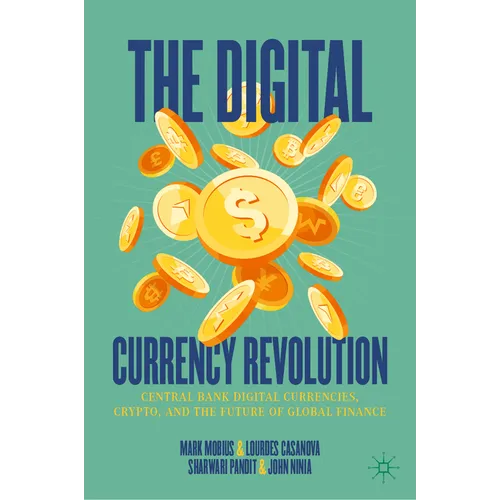
Product Description
by Mark Mobius (Author), Lourdes Casanova (Author), Sharwari Pandit (Author)
The past decade has seen an explosion of growth in digitalization, financial technology and mobile payments in emerging markets. The rise of global alternate financial systems has spurred central banks into action, fast-tracking solutions like Central Bank Digital Currencies (CBDCs) from the concept to pilot stage in several countries.
The rise in interest in CBDCs has been rapid and widespread - per the Atlantic Council's CBDC tracker, more than 95% of the global economy is considering the introduction of CBDC in some form. Although most of the world is interested in CBDCs, emerging markets have raced ahead in the implementation, pilots and launch of different models.
This book covers the emergence of digital payments, cryptocurrencies, and CBDCs. As emerging markets continue to experiment with these futuristic digital financial instruments systems, this book offers case studies across a range of countries and explores their unique economic and social context.
It provides an updated overview on the initiatives and their positive and negative consequences globally. Common arguments against CBDCs include concerns related to privacy and concentrating autonomy in central banks. In the US, arguments against CBDCs also highlight that if cash becomes obsolete, there is more government control and less privacy on our spending and financial transactions.
Lastly, this book explores the potential disruption in the global financial order unleashed by instruments like wholesale and retail CBDCs, cryptocurrencies, stablecoins, cross-border payment instruments, and digital payment systems. It engages in discussion relating to an ongoing policy war regarding financial payments and digital currencies and the possible dilution of the strength of physical currency.
Back Jacket
The past decade has seen an explosion of growth in digitalization, financial technology and mobile payments in emerging markets. The rise of global alternate financial systems has spurred central banks into action, fast-tracking solutions like Central Bank Digital Currencies (CBDCs) from the concept to pilot stage in several countries.
The rise in interest in CBDCs has been rapid and widespread - per the Atlantic Council's CBDC tracker, more than 95% of the global economy is considering the introduction of CBDC in some form. Although most of the world is interested in CBDCs, emerging markets have raced ahead in the implementation, pilots and launch of different models.
This book covers the emergence of digital payments, cryptocurrencies, and CBDCs. As emerging markets continue to experiment with these futuristic digital financial instruments systems, this book offers case studies across a range of countries and explores their unique economic and social context.
It provides an updated overview on the initiatives and their positive and negative consequences globally. Common arguments against CBDCs include concerns related to privacy and concentrating autonomy in central banks. In the US, arguments against CBDCs also highlight that if cash becomes obsolete, there is more government control and less privacy on our spending and financial transactions.
Lastly, this book explores the potential disruption in the global financial order unleashed by instruments like wholesale and retail CBDCs, cryptocurrencies, stablecoins, cross-border payment instruments, and digital payment systems. It engages in discussion relating to an ongoing policy war regarding financial payments and digital currencies and the possible dilution of the strength of physical currency.
Mark Mobius has spent over 40 years working in and travelling throughout emerging and frontier markets. During this time he has been in charge of actively managed funds totalling over $50 billion in assets. Prior to founding Mobius Investments in 2024, Dr. Mobius was with Franklin Templeton Investments for more than 30 years, most recently as executive chairman of the Templeton Emerging Markets Group.
Lourdes Casanova is a Senior Lecturer and the Director of the Emerging Markets Institute at the S.C. Johnson School of Management, Cornell University. She specializes in international business with a focus on emerging markets multinationals.
Sharwari Pandit is an Associate at McKinsey & Company in their Washington, D.C. office. She graduated with an M.B.A. from Cornell S.C. Johnson Graduate School of Management, where she served as a Fellow at the Emerging Markets Institute, focusing her research on digital payments and central bank digital currencies in emerging markets.
John Ninia collaborates with Mark Mobius, leveraging his expertise to identify investment opportunities across both public and private equities within emerging markets. John has been published by the Emerging Markets Institute and the International Banker.
Author Biography
Mark Mobius has spent over 40 years working in and travelling throughout emerging and frontier markets. During this time he has been in charge of actively managed funds totalling over $50 billion in assets. Prior to founding Mobius Investments in 2024, Dr. Mobius was with Franklin Templeton Investments for more than 30 years, most recently as executive chairman of the Templeton Emerging Markets Group.
Lourdes Casanova is a Senior Lecturer and the Director of the Emerging Markets Institute at the S.C. Johnson School of Management, Cornell University. She specializes in international business with a focus on emerging markets multinationals. Sharwari Pandit is an Associate at McKinsey & Company in their Washington, D.C. office. She graduated with an M.B.A. from Cornell S.C. Johnson Graduate School of Management, where she served as a Fellow at the Emerging Markets Institute, focusing her research on digital payments and central bank digital currencies in emerging markets. John Ninia collaborates with Mark Mobius, leveraging his expertise to identify investment opportunities across both public and private equities within emerging markets. John has been published by the Emerging Markets Institute and the International Banker.