


Product Description
by Ulrich Holtmann (Author), Holger Keding (Author), Markus Wloka (Author)
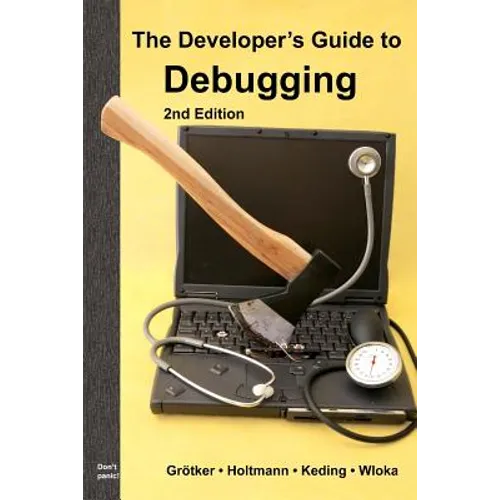
Software has bugs. Period. That's true, unfortunately. Even the good old "hello, world" program, known to virtually every C and C++ programmer in the world, can be considered to be buggy. Developing software means having to deal with defects; old ones, new ones, ones you created yourself and those that others brought to life. Software developers debug programs for a living. Hence, good debugging skills are a must-have. That said, I always found it regretable that debugging is hardly taught in engineering schools. Well, it is a tricky subject, and there are no good textbooks. The latter can be helped, I thought. That's how the idea for this book was born. "The Developer's Guide to Debugging" is a book for both professional software developers seeking to broaden their skills and students that want to learn the tricks of the trade from the ground up. With small inlined examples and exercises at the end of each chapter it is well suited to accompany a CS course or lecture. At the same time it can be used as a reference used to address problems as the need arises. This book goes beyond the level of simple source code debugging scenarios. In addition, it covers the most frequent real-world problems from the areas of program linking, memory access, parallel processing and performance analysis. The picture is completed by chapters covering static checkers and techniques to write code that leans well towards debugging. While the focus lies on C and C++, the workhorses of the software industry, one can apply most principles described in "The Developer's Guide to Debugging" to programs written in other languages. The techniques are not restricted to a particular compiler, debugger or operating system. The examples are structured such that they can be reproduced with free open-source software.
Author Biography
Thorsten Grötker was born in 1965 in Mönchengladbach, Germany. He received a diploma and doctorate degree in Electrical Engineering from Aachen University of Technology. Thorsten joined Synopsys in 1997, working in the areas of system level design and hardware verification. Ulli Holtmann was born in 1964 in Hildesheim, Germany. He studied Computer Science at the Technical University of Braunschweig and received his doctorate in 1995. He joined Synopsys in 1995 as an R&D engineer. From 1995-2000, he worked at the U.S. headquarters in Mountain View, and since then in Herzogenrath, Germany. Holger Keding was born in 1970 in Kempen, Germany. He studied Electrical Engineering and Information Technology at Aachen University of Technology, where he received his doctorate in 2002. He joined Synopsys in 2001 as Corporate Application Engineer, focusing on system level design and simulation methodology. Markus Wloka was born in Heidelberg in 1962, and grew up in Kiel, Germany. He received his Ph.D. in Computer Science in 1991 from Brown University, USA. From 1991-1996 he worked for Motorola SPS (now Freescale) in Tempe, USA. In 1996 he joined Synopsys in Germany, where he currently holds the position of Director R&D.