


Product Description
by Ryan J. Johnson (Author)
More than any other 20th-century philosopher, Deleuze considers himself an apprentice to the history of philosophy. But scholarship has ignored one of the more formative influences on Deleuze: Lucretian atomism.
Deleuze's encounter with Lucretius sparked a way of thinking that resonates throughout all his writings: from immanent ontology to affirmative ethics, from dynamic materialism to the generation of thought itself. Filling a significant gap in Deleuze Studies, Ryan J. Johnson tells the story of the Deleuze-Lucretius encounter that begins and ends with a powerful claim: Lucretian atomism produced Deleuzianism.
Back Jacket
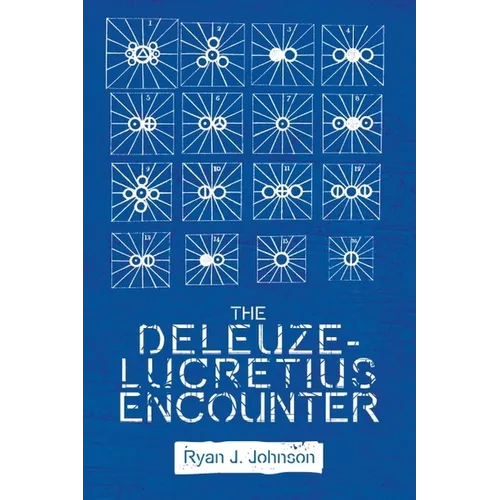
'Readers will be surprised and charmed at the parallels Ryan Johnson finds between Deleuze and Lucretius. The lines he draws from Ancient atomist ideas about relations, movements and speeds, through to Deleuzian materialism are exciting and convincing. The book is packed with interesting ideas and twists and is exacting in its scholarship. On top of that, it is beautifully written.' Jay Lampert, Duquesne University Deleuze's encounters with ancient philosophy More than any other twentieth-century philosopher, Deleuze considers himself an apprentice to the history of philosophy. This apprenticeship is organised around a series of encounters with singular thinkers that, taken together, form what Deleuze calls a 'minor tradition'. While several texts relate some of these encounters, especially with modern and contemporary figures, scholarship has ignored one of the more formative influences on Deleuze: Lucretian atomism. Deleuze's encounter with Lucretius sparked a way of thinking that resonates throughout all his writings: from immanent ontology to affirmative ethics, from dynamic materialism to the generation of thought itself. Filling a significant gap in Deleuze studies, Ryan J. Johnson tells the story of the Deleuze-Lucretius encounter that begins and ends with a powerful claim: Lucretian atomism produced Deleuzianism. Ryan J. Johnson is an Assistant Professor of Philosophy at Elon University, North Carolina. Cover image: Diameters of elastic atoms. John Dalton's diagram showing the diameters of elastic atoms from A New View of the Origin of Dalton's Atomic Theory, 1896 (c) Emilio Serge Visual Archives/American Institute of Physics/Science Photo Library Cover design: [EUP logo] edinburghuniversitypress.com ISBN 978-1-4744-1653-5 Barcode
Author Biography
Ryan J. Johnson is Assistant Professor of Philosophy at Elon University in North Carolina. He is the author of The Deleuze-Lucretius Encounter (EUP, 2017) and Nietzsche and Epicurus (Bloomsbury, 2020). He is co-editor of Contemporary Encounters with Ancient Metaphysics (EUP, 2017) and The Movement of Nothingness (Davies Group Publishers, 2012).