Product Description
by Dean Brooks (Author)
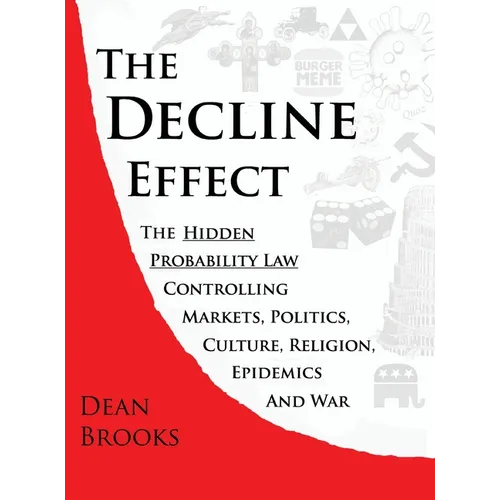
A crisis is coming for everyone who uses math and science. For decades now, the classical model of probability (the indifference principle and the Gaussian distribution) has been breaking down and revealing its limitations in fields from economics to epidemiology. Now a new approach has revealed the underlying non-classical principle behind all these 'anomalous' laws:
- Pareto's law of elite incomes
- Zipf's law of word frequencies
- Lotka's law of scientific publications
- Kleiber's law of metabolic rates
- the Clausewitz-Dupuy law of combat friction
- Moore's law of computing costs
- the Wright-Henderson cost law
- Weibull's law of electronics failures
- the Flynn Effect in IQ scores
- Benford's law of digit frequencies
- Farr's law of epidemics
- Hubbell's neutral theory of biodiversity
- Rogers' law of innovation classes
- Wilson's law of island biogeography
- Smeed's law of traffic fatalities
The general law behind all these particular laws (and countless others) is the "decline effect". As a system ages or grows in size, the rules of probability subtly change. Entropy increases, rare items become rarer, and average performance measures decline. The human meaning of a decline may be positive (decreasing costs, falling epidemic mortality) or negative (lower customer loyalty, decreasing efficiency), but the mathematical pattern is always the same. The implications are enormous, as these examples show:
All epidemic diseases decline in infectiousness and in lethality. HIV-AIDS went from a highly infectious, 95-percent fatal disease, to a survivable condition with a latency of decades. COVID-19 went from a death rate of 7 percent in early 2020, to under 2 percent in 2022.
Hereditary dynasties around the world declined smoothly in lifespan, from hundreds of years to tens of years. When democracies replaced monarchies, the decline (in spans of party control) continued.