Product Description
by Jay Winter (Author)
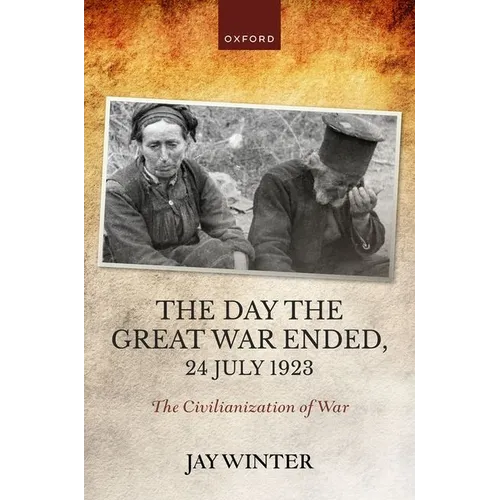
On 24 July 1923 the last Treaty ending hostilities in the Great War was signed at Lausanne in Switzerland. That Treaty closed a decade of violence. Jay Winter tells the story of what happened on that day. On the shores of Lake Geneva, diplomats, statesmen, and soldiers came from Ankara and Athens, from London, Paris, and Rome, and from other capital cities to affirm that war was over. The Treaty they signed fixed the boundaries of present-day Greece and Turkey, and marked a beginning of a new phase in their history.
That was its major achievement, but it came at a high price. The Treaty contained within it a Compulsory Population Exchange agreement. By that measure, Greek-Orthodox citizens of Turkey, with the exception of those living in Constantinople, lost the right of citizenship and residence in that state. So did Muslim citizens of Greece, except for residents of Western Thrace. This exchange of nearly two million people, introduced to the peace conference by Nobel Prize winner and humanitarian Fridtjof Nansen, provided a solution to the immense refugee problem arising out of the Greek-Turkish war. At the same time, it introduced into international law a definition of citizenship defined not by language or history or ethnicity, but solely by religion. This set a precedent for ethnic cleansing followed time and again later in the century and beyond. The second price of peace was the burial of commitments to the Armenian people that they would have a homeland in the lands from which they had been expelled, tortured and murdered in the genocide of 1915.This book tells the story of the peace conference, and its outcome. It shows how peace came before justice, and how it set in motion forces leading to the global war that followed in 1939.
Author Biography
Jay Winter, Charles J Stille Professor of History emeritus, Yale University
Jay Winter is an historian of the First World War, trained at Columbia and Cambridge. His first job was at the Hebrew University of Jerusalem; he then taught at Warwick, Cambridge, Columbia, and Yale, from which he retired in 2015. His work has focused on many facets of the history of the Great War, including labour history, demographic history, and most recently, cultural history. He has been active in public history as well as academic history. He was a founder of the Historial de la Grande Guerre, Péronne, and served on its board of directors of its research centre for 30 years.
Number of Pages: 256
Dimensions: 0.71 x 9.43 x 6.44 IN
Publication Date: January 06, 2023