


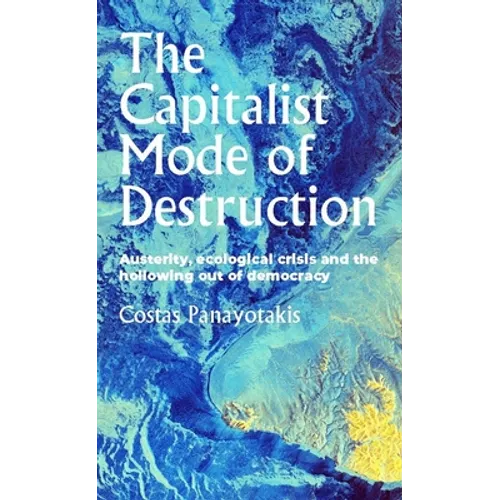
Product Description
by Costas Panayotakis (Author)
This book investigates capitalism's mounting destructiveness. Tracing today's economic, ecological and democratic crises to capitalism's undemocratic use of the surplus, Panayotakis highlights the necessity of a democratic classless society, which would restore control of the surplus to those who produce it.
Front Jacket
The capitalist mode of destruction traces contemporary capitalism's economic, ecological and democratic crises. Combining insights from a range of disciplines, including psychology, sociology and political economy, Panayotakis interprets these crises as manifestations of a previously unrecognized contradiction: over time, the benefits of capitalism's technological dynamism tend to decline even as its threats to humanity and the planet continue to mount. To explain this contradiction, the book analyzes the production and distribution of surplus in capitalist societies and rethinks the concept of surplus itself. Identifying the public sector and households as sites of production no less important than the workplace, this book attributes capitalism's contradictions to working people's lack of control over the surplus they produce. This lack of control is undemocratic and threatens the planet. Only a classless society, in which working people democratically determine the size and use of the surplus they produce, can effectively respond to our current predicament. Recognizing such a democratic classless society as the essence of the communist ideal, the book argues that, far from becoming obsolete, this ideal is ever more indispensable. But since the necessity of this ideal does not guarantee its realization, the book also investigates the conditions necessary for the formation of an anti-capitalist alliance for social justice, democracy and ecological sustainability.
Back Jacket
The capitalist mode of destruction traces contemporary capitalism's economic, ecological and democratic crises. Combining insights from a range of disciplines, including psychology, sociology and political economy, Panayotakis interprets these crises as manifestations of a previously unrecognized contradiction: over time, the benefits of capitalism's technological dynamism tend to decline even as its threats to humanity and the planet continue to mount.
To explain this contradiction, the book analyzes the production and distribution of surplus in capitalist societies and rethinks the concept of surplus itself. Identifying the public sector and households as sites of production no less important than the workplace, this book attributes capitalism's contradictions to working people's lack of control over the surplus they produce. This lack of control is undemocratic and threatens the planet. Only a classless society, in which working people democratically determine the size and use of the surplus they produce, can effectively respond to our current predicament. Recognizing such a democratic classless society as the essence of the communist ideal, the book argues that, far from becoming obsolete, this ideal is ever more indispensable. But since the necessity of this ideal does not guarantee its realization, the book also investigates the conditions necessary for the formation of an anti-capitalist alliance for social justice, democracy and ecological sustainability.Author Biography
Costas Panayotakis is Professor of Sociology at the New York City College of Technology at the City University of New York



