Product Description
by Charles River (Author)
*Includes pictures
*Includes a bibliography for further reading
The early history of Earth covers such vast stretches of time that years, centuries, and even millennia become virtually meaningless. Instead, paleontologists and scientists who study geochronology divide time into periods and eras. The current view of science is that Earth is around 4.6 billion years old, and the first 4 billion years of its development are known as the Precambrian period. For the first billion years or so, there was no life in Earth. Then the first single-celled life-forms, early bacteria and algae, began to emerge. It's unclear where they came from or even if they originated on this planet at all, but this gradual development continued until around four billion years ago when suddenly (in geological terms) more complex forms of life began to emerge.
Scientists call this time of an explosion of new forms of life the Paleozoic Era, and it stretched from around 541-250 million years ago (Mya). In the oceans and then on land, new creatures and plants began to appear in bewildering variety, and by the end of this period, life on Earth had diversified into a myriad of complex forms that filled virtually every habitat and niche available in the seas and on the planet's only continent, Pangea.
Despite all of the scientific advances made in the past few centuries, including an enhanced understanding of Earth's geological past, very little is known about the planet's early history. It is generally accepted that the planet formed somewhere in the region of 4.5 billion years ago, and at some point, the first life appeared in the form of tiny, single-celled creatures, but scientists are unsure of what this life looked like. One of the problems for those seeking to trace the history of life on Earth is that modern scholars are almost entirely dependent on fossil records, but the earliest types of life left few fossils. The best fossils are formed from the bones and hard body parts of dead creatures, but the earliest types of life were so small that they had no bones or cartilage and thus left no fossils. Thus, even though the Precambrian Period (4,600-541 millions of years ago (Mya)) covers over 80% of the entire history of the planet, scientists have very little idea of what forms of life existed then.
Then, as Earth entered the Cambrian Period, there was a relatively sudden increase in life form diversity throughout the oceans. Completely new forms of life, more complex and more diverse than anything that had been seen before, began to spread. This acceleration in the evolution of new forms of life was so dramatic that this has come to be known as the "Cambrian explosion."
Although new species in the Cambrian explosion developed almost entirely in the oceans, the land was not entirely devoid of life. Though there were no plants or animals, mats of cyanobacteria and other types of microbes covered large terrestrial areas. Scientists have discovered the tracks of a creature that were left in mud that existed 551 Mya, and those tracks were left by leg-like appendages. Was this a fish-like creature that temporarily invaded the land, or was it something completely different than anything that exists today? There is no general consensus, but the Cambrian Period left a rich fossil record that provides a clear idea of the development of life during this time. At the same time, new discoveries are continually being made, and the more scientists discover about this mysterious period, the more their understanding of ancient Earth changes.
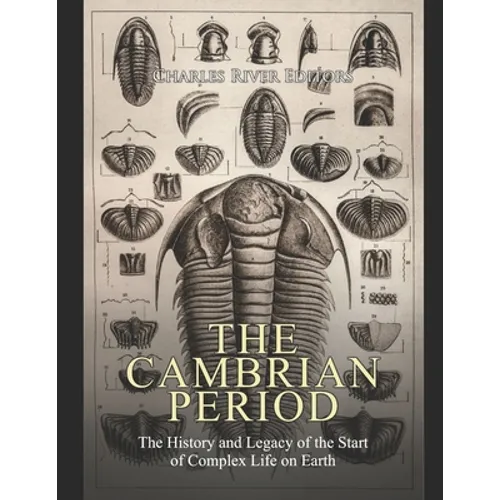
The Cambrian Period: The History and Legacy of the Start of Complex Life on Earth looks at the development of the era, the extinction event that preceded it, and how life began to evolve during it. Along with pictures depicting important people, places, and events, you will learn about the Cambrian Period like never before.