Product Description
by Nicholas Evan Sarantakes (Author)
A thrilling and in-depth look at the battle for Manila, the third-bloodiest battle of World War II and the culmination point of the war in the Pacific theater.
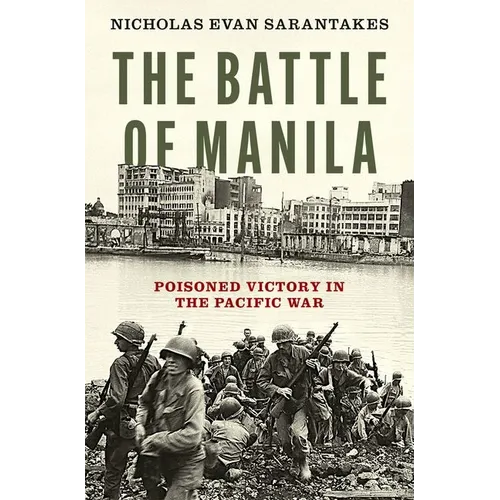
In 1945 the United States and Japan fought the largest and most devastating land battle of their war in the Pacific, a month-long struggle for the city of Manila. The only urban fighting in the Pacific theater, the Battle of Manila was the third-bloodiest battle of World War II, behind Leningrad and Berlin. It was a key piece of the campaign to retake control of the Philippine Islands, which itself signified the culmination of the war, breaking the back of Japanese strategic power and sealing its outcome. In The Battle of Manila, Nicholas Sarantakes offers the first in-depth account of this crucial campaign from the American, Japanese, and, significantly, Filipino perspective. Fighting was building by building, with both sides forced to adapt to the new combat environment. None of the U.S. units that entered Manila had any previous training in urban warfare--yet, Sarantakes shows, they learned on the fly how to use tanks, flamethrowers, air, and artillery assets in support of infantry assaults. Their effective use of these weapons was an important factor in limiting U.S. casualties, even as it may also have contributed to a catastrophic loss of civilian lives. The battle was a strategic U.S. victory, but Sarantakes reveals how closely it hinged upon the interplay between a series of key decisions in both U.S. and Japanese headquarters, and a professional culture in the U.S. military that allowed the Americans to adapt faster and in more ways than their opponents. Among other aspects of the conflict, The Battle of Manila explores the importance of the Filipino guerillas on the ground, the use of irregular warfare, the effective use of intelligence, the impact of military education, and the limits of Japanese resistance. Ultimately, Sarantakes shows Manila to be a major turning in both World War II and American history. Once the United States regained control of the city, Japan was in a checkmate situation. Their defeat was certain, and it was clear that the United States would be the dominate political power in post-war Asia and the Pacific. This fascinating account shines a light on one of the war's most under-represented and highly significant moments.Author Biography
Nicholas Evan Sarantakes is an associate professor in the strategy and policy department at the U.S. Naval War College. He is the author of four books, including Dropping the Torch: Jimmy Carter, the Olympic Boycott, and the Cold War.
Number of Pages: 528
Dimensions: 0.1 x 0.1 x 0.1 IN
Publication Date: February 03, 2025