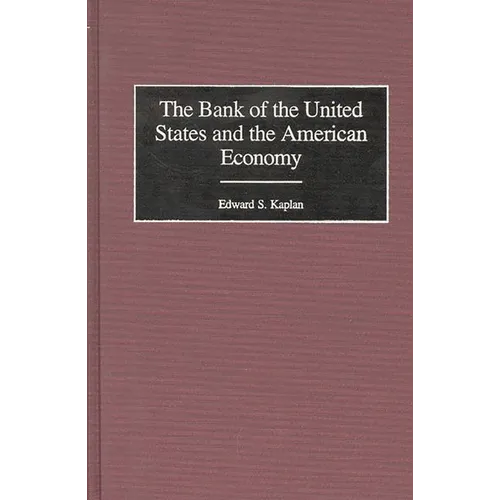
Product Description
by Edward Kaplan (Author)
An account of the history, structure, and operation of the First and Second Banks of the United States, this study examines how the banks performed as national and central institutions, and what happened to the economy when the charter of the Second Bank was allowed to expire in 1836. Historians have paid little recent attention to the early history of central banking in the United States, and many Americans believe that the Federal Reserve, created in 1913, was our first central bank. The economic crisis during the American Revolution actually led to the founding of a national bank, called the Bank of North America, during the period of Confederation. Although it became a private bank before the Constitution was ratified in 1788, it proved to be such a success that in 1791 Alexander Hamilton, the first Secretary of the Treasury, was able to convince President Washington that a similar bank should be established.
While the First Bank of the United States performed well during its tenure, its charter was allowed to lapse in 1811. A Second Bank of the United States was created five years later in 1816, and it prospered under the leadership of its third president, Nicholas Biddle, from 1823 to 1830, when central banking was practiced. This success ended with the 1828 election of Andrew Jackson, who refused to recharter the bank and withdrew the government's funds in 1833. Severely weakened, the Bank continued, but its charter finally expired in 1836, much to Biddle's dismay.Author Biography
EDWARD S. KAPLAN is Professor in the Department of Social Science at New York City Technical College of the City University of New York. He has co-authored Prelude to Trade Wars: American Tariff Policy, 1890--1922 (Greenwood, 1994), authored American Trade Policy, 1923--1995 (Greenwood, 1996), U.S. Imperialism in Latin America: Bryan's Challenges and Contributions, 1900--1920 (Greenwood, 1998), and has written several articles on U.S. economic history.