Product Description
by David G. Ainley (Author), Rory P. Wilson (Author)
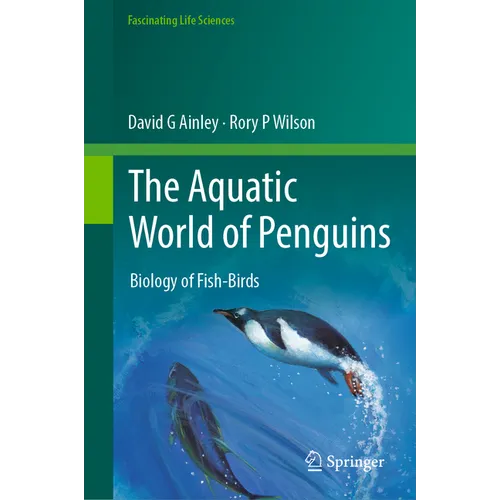
Centuries ago, when penguins were first encountered by European explorers, they were not thought to be birds but rather a fish-like relative. Subsequent accumulation of knowledge has shown penguins to be an avian species with unrivaled aquatic attributes, owing to a number of evolutionary adaptations: shape change, low drag, ability to regulate buoyancy, and extraordinary surface compliancy from their featheration. They are indeed the most extremely specialized diving bird, having given up flight (which otherwise is hugely advantageous) to the benefit of underwater prowess (such as speed, maneuverability and an ability to exploit an extraordinary range of depths). This flightlessness, however, also comes with costs that are substantial for a seabird (such as the inability to cover large distances quickly in reaction to ephemeral prey); and the energy needed to cope with moving through an aqueous environment, which is more resistant than air. For penguins, the high energetic costs in exploiting the ocean environment thus makes them especially sensitive to changes in food availability or their access to their prey.
While a number of "penguin books" cover the natural history, mainly of breeding aspects, few address in much detail the incredible aquatic nature of these creatures. A huge amount of information has been amassed over recent past decades thanks to dramatic advances in microelectronics, bio-logging and maturation of some long-term studies of penguin life history. This work represents an integration of all these data with charts, maps and graphs, along with richly illustrated photos by experts in the field.
Back Jacket
Centuries ago, when penguins were first encountered by European explorers, they were not thought to be birds but rather a fish-like relative. Subsequent accumulation of knowledge has shown penguins to be an avian species with unrivaled aquatic attributes, owing to a number of evolutionary adaptations: shape change, low drag, ability to regulate buoyancy, and extraordinary surface compliancy from their featheration. They are indeed the most extremely specialized diving bird, having given up flight (which otherwise is hugely advantageous) to the benefit of underwater prowess (such as speed, maneuverability and an ability to exploit an extraordinary range of depths). This flightlessness, however, also comes with costs that are substantial for a seabird (such as the inability to cover large distances quickly in reaction to ephemeral prey); and the energy needed to cope with moving through an aqueous environment, which is more resistant than air. For penguins, the high energetic costs in exploiting the ocean environment thus makes them especially sensitive to changes in food availability or their access to their prey.
While a number of "penguin books" cover the natural history, mainly of breeding aspects, few address in much detail the incredible aquatic nature of these creatures. A huge amount of information has been amassed over recent past decades thanks to dramatic advances in microelectronics, bio-logging and maturation of some long-term studies of penguin life history. This work represents an integration of all these data with charts, maps and graphs, along with richly illustrated photos by experts in the field.
Author Biography
David Ainley has studied the upper trophic level dynamics of marine ecosystems for more than 40 years, and is a world-recognized expert on Ad駘ie penguins. He has been on committees of the National Research Council to evaluate national environmental programs, was a member of the Marine Mammal Commission (Committee of Scientific Advisors) and state and international fisheries commissions, and has represented U.S. interests in various polar initiatives. Most recently, he initiated efforts that led to designation of the Ross Sea Region Marine Protected Area within international waters of the Southern Ocean. In addition, he has served as program head for meetings of the Western Field Ornithologists, Pacific Climate Conference, Pacific Seabird Group, American Ornithologists' Union, Cooper Ornithological Society, American Geophysical Union, and Scientific Committee on Antarctic Research. He has received the Lifetime Achievement Award from the Pacific Seabird Group, and in 2022 was awarded the Ralph W. Schreiber Conservation Award by the American Ornithological Societies. He has been Editor-in-Chief of Marine Ornithology for the past 10 years.
Rory Wilson is a professor in zoology within the department of biosciences at Swansea University, Wales, UK. He too, has been actively working with penguins for more than 40 years with understanding their marine ecology being his primary research thrust. His work involves developing and using new methods, particularly animal-attached tags, to study the behavioral ecology of enigmatic animals that are, otherwise, difficult to study. He has worked with ten penguin species but has also been involved in work in Africa, both Americas, Antarctica, Australia, the far- and middle East and Europe, with animals as diverse as albatrosses, armadillos, badgers, cheetahs, condors, sharks and sloths. He was bestowed a Rolex Award for Enterprise in 2006 for his animal tag developments. He was chief scientific consultant for Nat Geo's highly acclaimed 7-part series, 'Great Migrations', is listed in the top 50 conservationists in the BBC power list and is a Fellow of both the Learned Society of Wales and of Academia Europaea