


Product Description
by P. D. Ouspensky (Author)
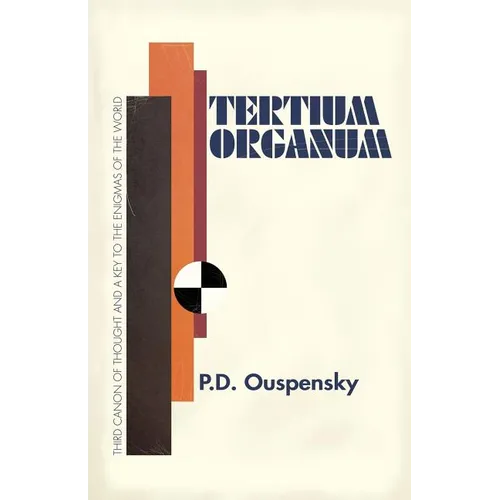
When Tertium Organum burst onto the New York literary scene its author, P. D. Ouspensky, was unaware of it. Piotr Demianovich Ouspensky, the most famous pupil of Greco-Armenian spiritual teacher George Ivanovitch Gurdjieff, had written Kluck Kzaradkam (the original title) in his native Russian and it had been published in St. Petersburg in 1912. At the time of its New York debut his whereabouts were unknown. A Russian by the name of Nicholas Bessarabof had emigrated to America before the 1917 Russian Revolution and had taken the book with him. He gave a copy to architect Claude Bragdon who could read Russian and was interested in forth-dimensional consciousness. After reading the book a friend echoed Bragdons' sentiments saying; "He has recently discovered a young Russian who "seems to us remarkable in many ways." The man has introduced him to Ouspensky and his book on the fourth dimension called Tertium Organum. Bragdon believes this book to be the "long sought New Testament of the Sixth Race which will justify the meekness of the saint, the vision of the mystic, and create a new heaven and a new earth." He is currently collaborating with Bessarabof on an English translation." In 1920 without Ouspensky's knowledge, Bragdon and Bessarabof published the book in English through Manas Press in New York. Meanwhile Ouspensky, a journalist and destitute author, had arrived in Constantinople with hardly a penny to his name. Later that year he was gratified to receive a substantial royalty check, and the news that Tertium Organum was a publishing success in English, and that his fame in literary circles was assured. In 1921 he wrote, "This translation, made without my knowledge and participation, at a time when I was cut off by war and revolution from the civilized world, transmits my thought so exactly that after a very attentive review of the book I could find only one word to correct. Such a result could be achieved only because Mr. Bessarabof and Mr. Bragdon were not translating words merely, but were grasping directly my thoughts at the back of them." In May 1921 Ouspensky received the sum of 100 from Lady Rothermere who was in Rochester, New York; it was wired with the message: 'Deeply impressed by your book Tertium Organum - wish to meet you in New York or London - will pay all expenses.' This invitation gave Ouspensky the opportunity to move to England where he secured Gurdjieff's permission to write a book on his philosophy. Ouspensky spent the next twenty years in England lecturing and teaching Gurdjieff's ideas and developing his own philosophy. His lectures in London were attended by such literary figures as Aldous Huxley, T. S. Eliot, and other writers, journalists and doctors. His influence on the literary scene of the 1920's and 1930's as well as on the Russian avant-garde was huge but today he is not widely known.