Skip to content
Save 5% on your next order with code PREMIUM5!
100,000+ Products for Home, Medical, Office & Classroom Needs
Search
Skip to product information
1 of 1

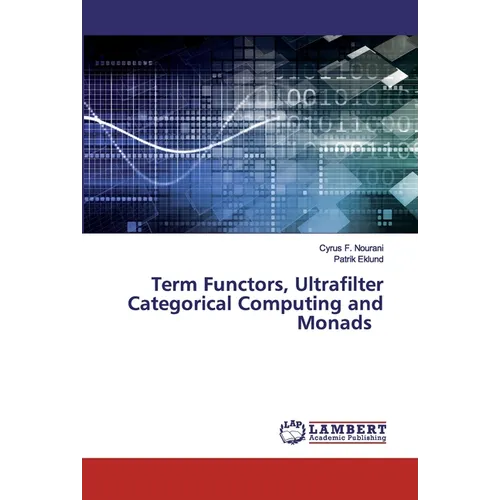
Term Functors, Ultrafilter Categorical Computing and Monads - Paperback

$153.81 USD
$153.81 USD
Sale Sold out
Shipping calculated at checkout.
In stock (100 units), ready to be shipped

Available Offers

Fast delivery available on most orders

Multiple secure payment options accepted

Secure checkout with
  • American Express
  • Apple Pay
  • Diners Club
  • Discover
  • Google Pay
  • Mastercard
  • PayPal
  • Shop Pay
  • Visa

Flight Range: Up to 1,000 meters (3,280 feet)

Maximum Speed: 45 kilometers per hour (28 miles per hour)

For all orders exceeding a value of 100USD shipping is offered for free.

Returns will be accepted for up to 10 days of Customer’s receipt or tracking number on unworn items. You, as a Customer, are obliged to inform us via email before you return the item.

Otherwise, standard shipping charges apply. Check out our delivery Terms & Conditions for more details.

View Product Details
Shopping cart
Product Product subtotal Quantity Price Product subtotal
Term Functors, Ultrafilter Categorical Computing and Monads - Paperback
$153.81/ea
$0.00
$153.81/ea $0.00

Product Description

by Cyrus F. Nourani (Author), Patrik Eklund (Author)

This book is an introduction to a term functorial mathematics and monad-based model theory on infinitary language categories. Term functors are important new techniques that bring categorical models mathematics bases closer to computability studies. The book bridges over important areas between CS and Mathematics with newer important insights. Lifting to power signatures to bridge onto n-type functors with ultrafilters for computability with n-type models for point set fragments. The accomplishment bring forth newer avenues between mathematics and TCS with newer benefits to both disciplines. The functorial model perspective is different from the preceding authors', in that functorial model theory is based on defining categories on language fragments, then carrying on functors to categories and filter monads. Infinitary language categories abbreviated IFLCS in the first authors publications over a decade ago. An important consequence is that we have a direct reach to all developed model theory techniques at categories. Therefore, we do not reinvent all that at topos, but carry that at topos.


Number of Pages: 456
Dimensions: 1.02 x 9 x 6 IN
Publication Date: September 18, 2020
you might like
