Product Description
by Kelly Pender (Author)
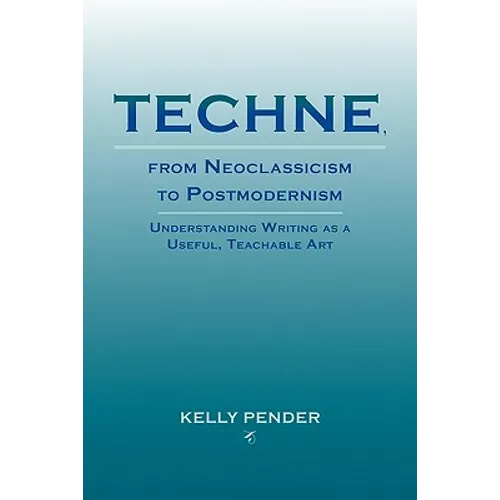
Kelly Pender's final provocative suggestion-that it is precisely through the apparent opposition between "closed" and "open" that writing itself has been marginalized within the writing classroom-is an extraordinarily insightful point, one that deserves serious consideration within the rhetoric and composition community. -John Muckelbauer, author of Invention and the Future: Rhetoric, Postmodernism, and the Problem of Change The word techne has no equivalent in English and so is usually understood as one of the three terms that approximate its original Greek meaning: art, skill, craft. As a kind of productive knowledge, techne is often defined by its close association with rationality and instrumentality. TECHNE, FROM NEOCLASSICISM TO POSTMODERNISM: UNDERSTANDING WRITING AS A USEFUL, TEACHABLE ART is a book about the relationships among the many meanings of this complex term. Kelly Pender tells the story of techne's presence in the development of rhetoric and composition as an academic discipline in the mid-twentieth century, the influence of postmodern theory on that development, and what is often taught or not taught under the rubric of "writing" in contemporary composition courses. The arguments TECHNE, FROM NEOCLASSICISM TO POSTMODERNISM makes about these relationships are deconstructive and seek to challenge some of the field's most firmly entrenched binaries about what writing is and how (or if) it should be taught. To make these arguments, TECHNE, FROM NEOCLASSICISM TO POSTMODERNISM uses Samuel Weber's retranslation of the Heideggerian term "Ge-stell" as a form of emplacement to show how composition theories and pedagogies based on techne work simultaneously to both "close down" and "open up" possibilities for experiencing writing as an inherently valuable, nonrational mode of bringing-forth. KELLY PENDER holds a PhD in English from Purdue University. She is an assistant professor of English at Virginia Tech, where she teaches courses in professional writing, public discourse, critical theory, and classical rhetoric. She has presented papers at numerous conferences, and her work has appeared in journals such as Postmodern Culture, Composition Studies, and Rhetoric Society Quarterly. Her research interests include the history and theory of rhetoric and composition, critical theory, and, medical rhetoric, particularly rhetorics of genetic risk and disease prevention.