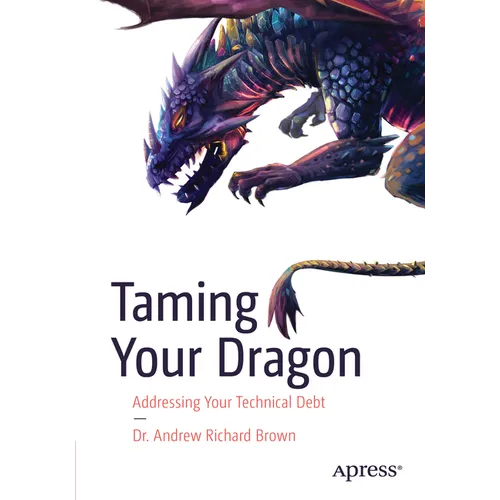
Product Description
by Andrew Richard Brown (Author)
Technical debt is an often-overlooked problem that the software industry needs to take more seriously. All organizations are impacted by it, most wish that they had less of it, but need help in understanding the nature of the beast. This book aims to clear up any misconceptions and show you how to implement a sound technical debt management program to suit your company's needs.
You'll learn the greatest challenge in solving the technical debt dilemma is not to find solutions to it, but rather to find solutions to the human and organizational issues that lead to that debt. For example, convincing senior stakeholders of the importance of addressing technical debt, getting stakeholders to acknowledge how their actions lead to unintentional debt, and enabling teams to prioritize technical debt over short-term goals.
Therefore, this book is divided into three parts: defining technical debt, understanding technical debt, and tackling technical debt. It begins by explaining why technical debt should not be considered a technical problem, but rather a problem of how trade-off decisions are made. You'll then examine how making decisions using the affect heuristic, more commonly known as a "gut feeling," can lead to unnecessary technical debt, followed by some techniques for combating your vulnerability to this trap.
Reducing your organization's level of technical debt is not easy. Taming Your Dragon will show you how to implement a technical debt management program.
What You Will Learn
- Review a new paradigm based on technical debt being a combination of trade-off problems and system problems
- Understand the many ways that technical debt adversely affects an organization's ability to deliver IT change
- Create an effective process for addressing technical debt
- See why analogies are important
Who This Book Is For
Software teams supporting DevOps, managers, and other business stakeholders looking to implement a technical debt management program.
Back Jacket
Technical debt is an often-overlooked problem that the software industry needs to take more seriously. All organizations are impacted by it, most wish that they had less of it, but need help in understanding the nature of the beast. This book aims to clear up any misconceptions and show you how to implement a sound technical debt management program to suit your company's needs.
You'll learn the greatest challenge in solving the technical debt dilemma is not to find solutions to it, but rather to find solutions to the human and organizational issues that lead to that debt. For example, convincing senior stakeholders of the importance of addressing technical debt, getting stakeholders to acknowledge how their actions lead to unintentional debt, and enabling teams to prioritize technical debt over short-term goals.
Therefore, this book is divided into three parts: defining technical debt, understanding technical debt, and tackling technical debt. It begins by explaining why technical debt should not be considered a technical problem, but rather a problem of how trade-off decisions are made. You'll then examine how making decisions using the affect heuristic, more commonly known as a "gut feeling," can lead to unnecessary technical debt, followed by some techniques for combating your vulnerability to this trap.
Reducing your organization's level of technical debt is not easy. Taming Your Dragon will show you how to implement a technical debt management program.
You will:
- Review a new paradigm based on technical debt being a combination of trade-off problems and system problems
- Understand the many ways that technical debt adversely affects an organization's ability to deliver IT change
- Create an effective process for addressing technical debt
- See why analogies are important
Author Biography
Andrew Richard Brown has worked in the software industry since 1999. He started as an SAP programmer fixing Y2K bugs, although he admits that he sometimes inadvertently replaced them with Y-2050 bugs. Later, he realized that the biggest problems in software development were not technical but human. What's more, nobody had yet figured out what to do about them! Since then, he has helped teams improve their performance through understanding and addressing these problems.
Andrew also coaches organizations on software development, quality engineering, and addressing issues driven by human factors. He is particularly active in addressing long-standing issues, like technical debt, risk in complex systems, and project underestimation. He investigates how software development problems are driven by cognitive biases, plus how to address them using behavioral science techniques.
His research has led to new and counterintuitive insights into the true causes of software development problems, as well as fresh approaches to solving them. He is a regular speaker at international software conferences and has a growing YouTube channel dedicated to understanding these problems.