


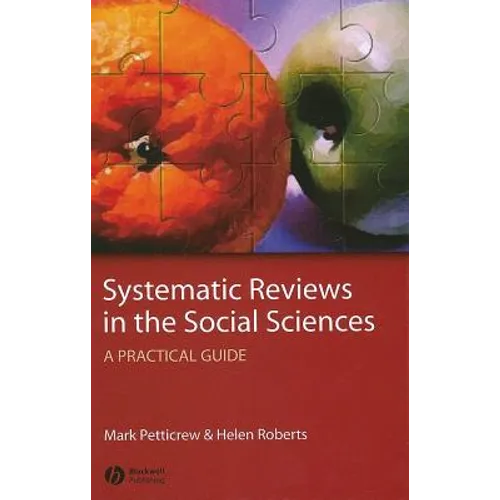
Product Description
by Mark Petticrew (Author), Helen Roberts (Author)
Such diverse thinkers as Lao-Tze, Confucius, and U.S. Defense Secretary Donald Rumsfeld have all pointed out that we need to be able to tell the difference between real and assumed knowledge. The systematic review is a scientific tool that can help with this difficult task. It can help, for example, with appraising, summarising, and communicating the results and implications of otherwise unmanageable quantities of data.
This book, written by two highly-respected social scientists, provides an overview of systematic literature review methods:
- Outlining the rationale and methods of systematic reviews;
- Giving worked examples from social science and other fields;
- Applying the practice to all social science disciplines;
- It requires no previous knowledge, but takes the reader through the process stage by stage;
- Drawing on examples from such diverse fields as psychology, criminology, education, transport, social welfare, public health, and housing and urban policy, among others.
- Including detailed sections on assessing the quality of both quantitative, and qualitative research; searching for evidence in the social sciences;
meta-analytic and other methods of evidence synthesis; publication bias; heterogeneity; and approaches to dissemination.
Back Jacket
Such diverse thinkers as Lao-Tze, Confucius, and US Defense Secretary Donald Rumsfeld have all pointed out that we need to be able to tell the difference between real and assumed knowledge. The systematic review is a scientific tool that can help with this difficult task. It can help, for example, with appraising, summarising, and communicating the results and implications of otherwise unmanageable quantities of data. This is important because quite often there are so many studies, and their results are often so conflicting, that no policymaker or practitioner could possibly carry out this task themselves.
Systematic review methods have been widely used in health care, and are becoming increasingly common in the social sciences (fostered, for example, by the work of the Campbell Collaboration). This book outlines the rationale and methods of systematic reviews, giving worked examples from social science and other fields. It requires no previous knowledge, but takes the reader through the process stage by stage. It draws on examples from such diverse fields as psychology, criminology, education, transport, social welfare, public health, and housing and urban policy, among others.
The book includes detailed sections on assessing the quality of both quantitative, and qualitative research; searching for evidence in the social sciences; meta-analytic and other methods of evidence synthesis; publication bias; heterogeneity; and approaches to dissemination.
Author Biography
Mark Petticrew is an associate director of the MRC Social and Public Health Sciences Unit at the University of Glasgow, Co-ordinator of the ESRC Centre for Evidence-Based Public Health Policy, and has written widely on systematic reviews.
Helen Roberts is a social scientist, and professor of Child Health at City University, where she leads the Child Health Research and Policy Unit. Until 2001 she was Head of R&D at Barnardos. Her most recent book is What Works for Children (ed) with Di McNeish and Tony Newman.



