


Product Description
by Lynette Jackson (Author)
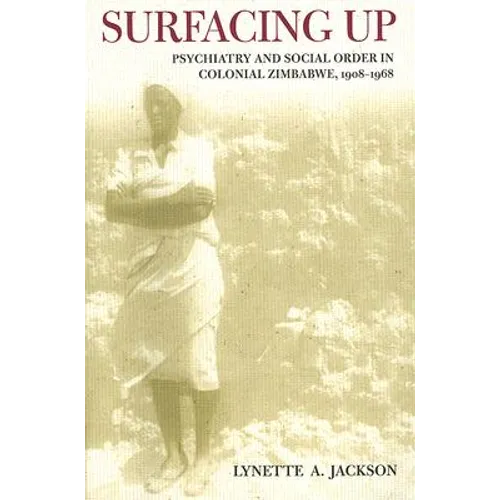
Focusing on the history of the Ingutsheni Lunatic Asylum (renamed a mental hospital after 1933), situated near Bulawayo in the former Southern Rhodesia, Surfacing Up explores the social, cultural, and political history of the colony that became Zimbabwe after gaining its independence in 1980. The phrase "surfacing up" was drawn from a conversation Lynette A. Jackson had with a psychiatric nurse who used the concept to explain what brought African potential patients into the psychiatric system. Jackson uses Ingutsheni as a reference point for the struggle to "domesticate" Africa and its citizens after conquest. Drawing on the work of Frantz Fanon, Jackson maintains that the asylum in Southern Rhodesia played a significant role in maintaining the colonial social order. She supports Fanon's claim that colonial psychiatric hospitals were repositories for those of "indocile nature" or for those who failed to fit "the social background of the colonial type."
Through reconstruction and reinterpretation of patient narratives, Jackson shows how patients were diagnosed, detained, and deemed recovered. She draws on psychiatric case files to analyze the changing economic, social, and environmental conditions of the colonized, the varying needs of the white settlers, and the shifting boundaries between these two communities. She seeks to extend and enrich our understanding of how a significant institution changed the way citizens and subjects experienced the colonial social order.
Author Biography
Lynette A. Jackson is Associate Professor of Gender and Women's Studies and African American Studies at the University of Illinois at Chicago.



