


Product Description
by Michael G. Miller (Author)
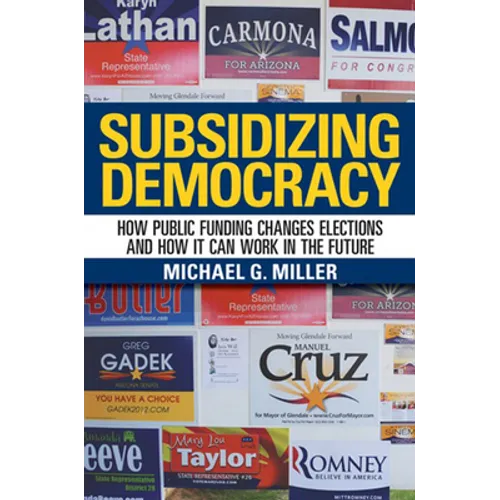
In the wake of Citizens United v. Federal Election Commission (2010), the case that allowed corporate and union spending in elections, many Americans despaired over the corrosive influence that private and often anonymous money can have on political platforms, campaigns, and outcomes at the federal and state level. In McComish v. Bennett (2011), the Supreme Court declared unconstitutional the matching funds feature of so-called "Clean Elections" public financing laws, but there has been no strong challenge to the constitutionality of public funding as such. In Subsidizing Democracy, Michael G. Miller considers the impact of state-level public election financing on political campaigns through the eyes of candidates. Miller's insights are drawn from survey data obtained from more than 1,000 candidates, elite interview testimony, and twenty years of election data. This book is therefore not only an effort to judge the effects of existing public election funding but also a study of elite behavior, campaign effects, and the structural factors that influence campaigns and voters.The presence of publicly funded candidates in elections, Miller reports, results in broad changes to the electoral system, including more interaction between candidates and the voting public and significantly higher voter participation. He presents evidence that by providing neophytes with resources that would have been unobtainable otherwise, subsidies effectively manufacture quality challengers. Miller describes how matching-funds provisions of Clean Elections laws were pervasively manipulated by candidates and parties and were ultimately struck down by the Supreme Court. A revealing book that will change the way we think about campaign funding, Subsidizing Democracy concludes with an evaluation of existing proposals for future election policy in light of Miller's findings.
Author Biography
Michael G. Miller is Assistant Professor in the Department of Political Science and the Institute for Legal, Legislative and Policy Studies at the University of Illinois, Springfield.