


Product Description
by Benjamin H. Dunning (Author)
The first Christians operated with a hierarchical model of sexual difference common to the ancient Mediterranean, with women considered to be lesser versions of men. Yet sexual difference was not completely stable as a conceptual category across the spectrum of formative Christian thinking. Rather, early Christians found ways to exercise theological creativity and to think differently from one another as they probed the enigma of sexually differentiated bodies.
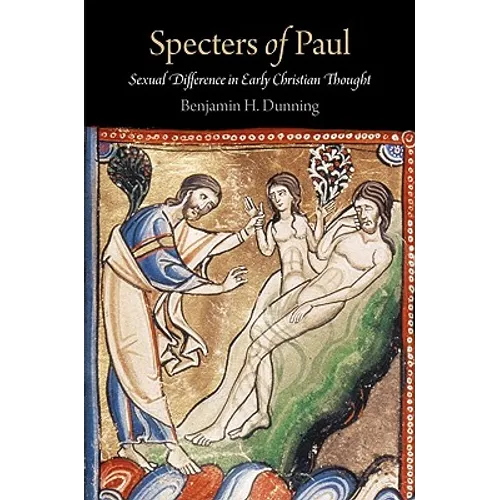
In Specters of Paul, Benjamin H. Dunning explores this variety in second- and third-century Christian thought with particular attention to the ways the legacy of the apostle Paul fueled, shaped, and also constrained approaches to the issue. Paul articulates his vision of what it means to be human primarily by situating human beings between two poles: creation (Adam) and resurrection (Christ). But within this framework, where does one place the figure of Eve--and the difference that her female body represents?
Dunning demonstrates that this dilemma impacted a range of Christian thinkers in the centuries immediately following the apostle, including Clement of Alexandria, Irenaeus of Lyons, Tertullian of Carthage, and authors from the Nag Hammadi corpus. While each of these thinkers attempts to give the difference of the feminine a coherent place within a Pauline typological framework, Dunning shows that they all fail to deliver fully on the coherence that they promise. Instead, sexual difference haunts the Pauline discourse of identity and sameness as the difference that can be neither fully assimilated nor fully ejected--a conclusion with important implications not only for early Christian history but also for feminist and queer philosophy and theology.
Author Biography
Benjamin H. Dunning teaches theology at Fordham University and is the author of Aliens and Sojourners: Self as Other in Early Christianity, also published by the University of Pennsylvania Press.



