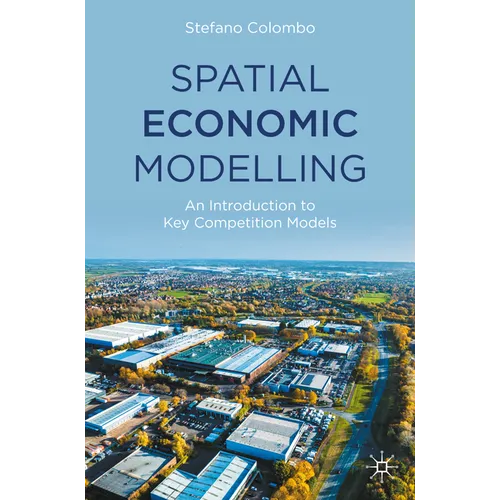
Product Description
by Stefano Colombo (Author)
This textbook provides an accessible introduction to spatial competition models in economics. It shows students how to understand and apply spatial models to analysis of market design, structure, competition and pricing.
The book aims to provide a step-by-step guide to learning and implementing spatial modelling. It provides a concise history of the spatial approach and a self-contained primer chapter on the key game theory tools required to undertake spatial analysis. It then provides a comprehensive explanation of the key traditions and models, including the Hotelling model and related Salop circle model, and demonstrates their various applications to consumer, firm and market interactions. Topics covered in the book include: product differentiation, the physical location of firms, spatial price discrimination, oligopolistic competition, non-uniform distributions of consumers, political competition and the basic Downs model, and the application of spatial models to marketing and management. This book will be a valuable resource for undergraduate students in microeconomics and applied economics, particularly on industrial organization courses.
Back Jacket
"Distinguished by its comprehensive and illuminating exploration of spatial competition models, this work extends beyond standard frameworks to showcase a remarkable range of variations rarely found together in this literature. Expertly balancing theoretical rigor with compelling real-world applications across diverse domains, it stands out as the definitive resource for researchers, students, and practitioners interested in spatial competition." - Yiquan Gu, Professor of Spatial Economics and Industrial Organisation, Henley Business School, University of Reading
This textbook provides an accessible introduction to spatial competition models in economics. It shows students how to understand and apply spatial models to analysis of market design, structure, competition and pricing.
The book aims to provide a step-by-step guide to learning and implementing spatial modelling. It provides a concise history of the spatial approach and a self-contained primer chapter on the key game theory tools required to undertake spatial analysis. It then provides a comprehensive explanation of the key traditions and models, including the Hotelling model and related Salop circle model, and demonstrates their various applications to consumer, firm and market interactions. Topics covered in the book include: product differentiation, the physical location of firms, spatial price discrimination, oligopolistic competition, non-uniform distributions of consumers, political competition and the basic Downs model, and the application of spatial models to marketing and management. This book will be a valuable resource for undergraduate students in microeconomics and applied economics, particularly on industrial organization courses.
Stefano Colombo is Professor of Economics at Universit? Cattolica del Sacro Cuore, Milan, Italy. He has published widely in spatial economics, price competition, game theory, regional economics, and microeconomic theory. He edited a two-volume collection with Palgrave on cutting edge research in spatial economics in 2020.
Author Biography
Stefano Colombo is Professor of Economics at Università Cattolica del Sacro Cuore, Milan, Italy. He has published widely in spatial economics, price competition, game theory, regional economics, and microeconomic theory. He edited a two-volume collection with Palgrave on cutting edge research in spatial economics in 2020.