Product Description
by Moritz Schlick (Author), Henry Leopold Brose (Translator), F. A. Lindeman (Foreword by)
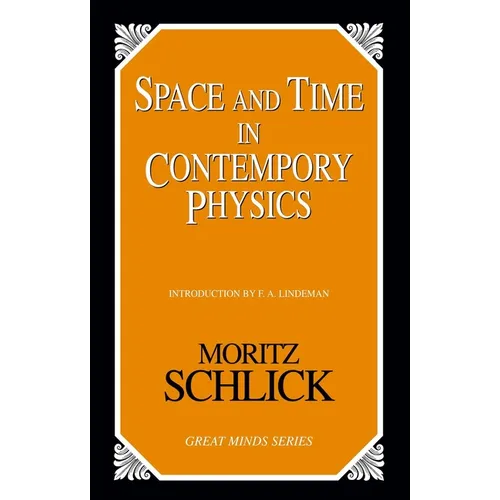
This is one of the clearest expositions in layperson's terms of Einstein's theory of relativity and its paradigm-shifting implications for philosophy and commonsense notions of reality. Moritz Schlick, the influential German philosopher and leader of the positivist school of philosophy known as the Vienna Circle, wrote this short work in 1919 specifically to introduce readers unfamiliar with Einstein's theories to the profound importance of the physicist's immense contributions. Einstein himself reviewed Schlick's work before publication and is thanked in the preface for "giving me many useful hints." With a talent for illustrative analogies and a concise, lucid style of presentation, Schlick explains both the special and the general theories of relativity. Beginning with the older Newtonian view of space, time, and the laws governing matter, the author proceeds to show how Einstein's theories solved certain problems inherent in the old view and provided a radical new conception of reality. Separate chapters discuss the special principle of relativity, the geometrical relativity of space, the mathematical formulation of special relativity, the inseparability of geometry and physics in experience, the relativity of motions and the connection with inertia and gravitation, the general theory of relativity, the significance of Einstein's fundamental new law, the finitude of the universe, and the impact of Einstein's ideas on philosophy. Since their original publication, numerous experiments have confirmed Einstein's ideas. Thus, Schlick's work continues to be a valuable and highly accessible explication of one of science's most enduring achievements.
Author Biography
Moritz Schlick, a German philosopher and the founding father of logical positivism, was born in Berlin to a wealthy family on April 14, 1882. He studied physics at Heidelberg, Lausanne, and, ultimately, the University of Berlin under Max Planck. In 1904 he completed his dissertation essay, "On the Reflection of Light in a Non-Homogenous Medium." In 1908 he published The Wisdom of Life, a volume about eudaemonism, the theory that happiness is the highest ethical pursuit. Schlick then turned his attention to problems of epistemology, the philosophy of science, and more general questions about science. He distinguished himself by publishing a 1915 paper on Einstein's special theory of relativity, a topic barely ten years old. Space and Time in Contemporary Physics was published in 1919.
Schlick became a professor in the philosophy of inductive sciences at the University of Vienna in 1922. That same year, a group of scientists and philosophers--including Rudolf Carnap, Herbert Feigl, Kurt Gödel, Hans Hahn, Otto Neurath, and Friedrich Waismann--suggested to Schlick that they meet regularly to discuss science and philosophy. Although they initially called themselves the Ernst Mach Association, they have been more commonly known as the Vienna Circle. The circle drew on the work of Bertrand Russell and Ludwig Wittgenstein as they were united by their hostility toward abstractions of metaphysics and their belief in grounding philosophical statements on empirical evidence. The reputation of the circle grew around the world as it published journal articles and books, including The Scientific View of the World: The Vienna Circle--a tribute to Schlick. With the rise of Nazism in Germany and Austria, however, many of the Vienna Circle's members left for the United States and the United Kingdom, but Schlick remained at the University of Vienna. On June 22, 1936, Schick was climbing some steps as he walked to class when he was confronted by a former student, Johann Nelböck, who drew a pistol and shot Schlick in the chest. He died shortly afterward. Without Schlick, the Vienna Circle ceased meeting.