Product Description
by Ben Witherington (Author)
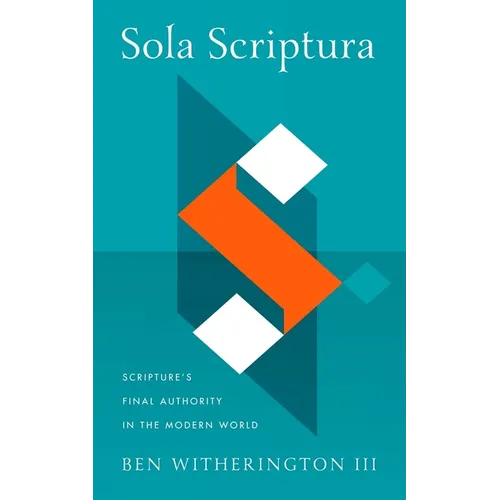
In modern times, evangelical Protestants have advocated for the belief that the Bible is the only real standard of truth and true Christian praxis for the church. But is this how the early Jews and Christians, who wrote the biblical books, viewed their sacred texts? And what counted as those sacred texts? Furthermore, there is often a lack of clarity as to what is meant by the famous phrase that became a motto of the German Reformation: sola scriptura. Does it mean that the Bible is the only authority for Christian faith and practice, or does it mean the Bible is the final authority, allowing non-biblical traditions, human reason, and perhaps even experience to have some authority in the church?
With this magisterial study, Ben Witherington III invites readers to go back to the time of the writing of the Bible and look at what is said about the sacred texts with a specific focus on how the authority of such texts was viewed. Witherington then walks through Christian history until the point where the phrase sola scriptura actually appears as an authority claim of some kind. Surprisingly, it does not show up until the fourteenth century A.D. and not in the writings of a Protestant. From there, Witherington examines how the phrase continued to be used in the various Reformations and into the modern era. The story of Sola Scriptura also involves the rise of science, the effect of the Enlightenment, and changes in views about human sexuality that have affected the discussion of the Bible's authority in various ways.
Students of Scripture, budding scholars, pastors, and laity alike stand to benefit from this book as Christians of all stripes are confronted by the same crises: a profound historical amnesia that is affecting even churches that are bibliocentric; the general chaos in Western culture that has further alienated younger generations from the church and angered the older generations who still attend church; and the increasing biblical illiteracy in the church, including in its pulpits, which has led to churches taking their signals and sense of direction from the culture rather than the biblical witness itself. Such crises will not be overcome without a serious coming to grips with the Bible, its history, and its authority for the Christian life.
Author Biography
Ben Witherington III is Professor of New Testament for Doctoral Studies, Asbury Theological Seminary. His publications include Troubled Waters: Rethinking the Theology of Baptism (2007), Making a Meal of It: Rethinking the Theology of the Lord's Supper (2007), The Living Word of God: Rethinking the Theology of the Bible (2007), What's in the Word: Rethinking the Socio-Rhetorical Character of the New Testament (2009), and The Problem with Evangelical Theology: Testing the Exegetical Foundations of Calvinism, Dispensationalism, Wesleyanism, and Pentecostalism, Revised and Expanded Edition (2015).