


Product Description
by Sawako Shirahase (Editor)
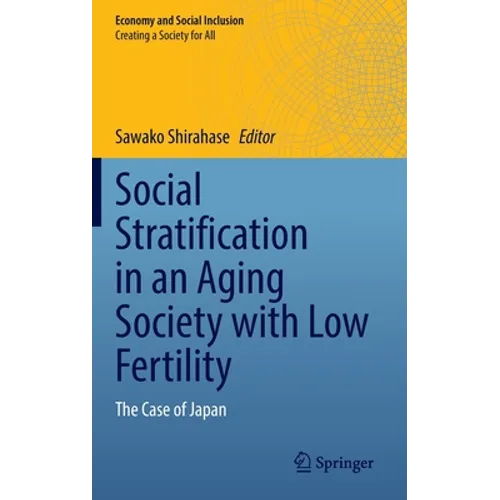
This edited book empirically discusses stratification in contemporary Japanese society. It is unique for its examination of social inequality in relation to declining fertility and an aging population. Japan is the most aged society in the world: according to the Statistics Bureau of Japan, people who are aged 65 and above comprised 29.1% of the country's total population in 2021. Meanwhile, the fertility rate has continuously declined since the mid-1970s.
Japan experienced a dramatic change in its demographic structure in a short period of time. Such fast change could be a major factor that generated social stratification. In her industrialization, Japan was thought to share a pattern of social stratification similar to that of developed European and North American countries but with a low degree of socio-economic inequality and a high degree of homogeneity. There is no clear support for this description of Japan, although the country does share a pattern and degree of social stratification similar to that observed in Europe and North America.
The social stratification theory has been developed in close relationship to the labor market; however, it is necessary to further examine the social stratification of very aged societies in which a substantial number of the population--namely, retired persons--no longer have any ties to the labor market. In this book, the contributors explore the pattern of social stratification at three life stages: young, middle-aged, and elderly. Included are discussions of various aspects of stratification such as education, work, wealth, marriage, family, gender, generation, and social attitudes.
Back Jacket
This edited book discusses stratification in contemporary Japanese society. It is unique for its empirical examination of social inequality in relation to declining fertility and an aging population. Japan is the most aged society in the world: according to the Statistics Bureau of Japan, people who are aged 65 and above accounted for 29.1% of the country's total population in 2021. Meanwhile, the fertility rate has continuously declined since the mid-1970s.
Japan experienced a dramatic change in its demographic structure in a short period of time. Such fast change could be a major factor in generating social stratification. In her industrialization, Japan was thought to share a pattern of social stratification similar to that of developed European and North American countries but with a low degree of socio-economic inequality and a high degree of homogeneity. There is no clear support for this description of Japan, although the country does share a pattern and degree of social stratification similar to that observed in Europe and North America.
The social stratification theory has been developed in close relation to the labor market; however, it is necessary to further examine the social stratification of very aged societies in which a substantial number of the population--namely, retired persons--no longer have any ties to the labor market. In this book, the contributors explore the pattern of social stratification at three life stages: young, middle-aged, and elderly. Included are discussions of various aspects of stratification such as education, work, wealth, marriage, family, gender, generation, and social attitudes.
Sawako Shirahase is Professor of Sociology at the Graduate School of Humanities and Sociology, The University of Tokyo.
Author Biography
Sawako Shirahase is Professor of Sociology at the Graduate School of Humanities and Sociology, the University of Tokyo. She received her D.Phil. in sociology from the University of Oxford, conducted post-doctoral research at the East Asian Institute, Columbia University as a junior researcher, and held positions of Senior Research fellow at the National Institute of Population and Social Security Research, and Associate Professor of Sociology at Tsukuba University. She is currently a director of the UTokyo Center for Contemporary Japanese Studies.
Dr. Shirahase's research interests include comparative social stratification and demographic transformation, gender and generational relations, and family change and social security system. She is the author of Social Inequality in Japan (Routledge, 2014) and Demographic Change and Inequality in Japan (ed.) (Trans Pacific Press, 2011), and her recent publications are "Social Stratification Theory and Population Aging Reconsidered," (Social Science Japan Journal 24(2): 277-288, 2021) and The Structure of Social Stratification in the Late-stage of Life (in Japanese) (ed., with S. Arita and N. Sudo) (University of Tokyo Press, 2021).
Dr. Shirahase is on the editorial board of International Sociology and Contemporary Japan, and on the advisory board of Social Politics. She currently serves as Vice President of the International Sociological Association and Vice President of the International Science Council. She was the principal investigator of the research project conducting the 2015 National Survey of Social Stratification and Social Mobility (SSM) Survey which has been conducted every 10 years since 1955.



