


Product Description
by Amanda J. Weidman (Author)
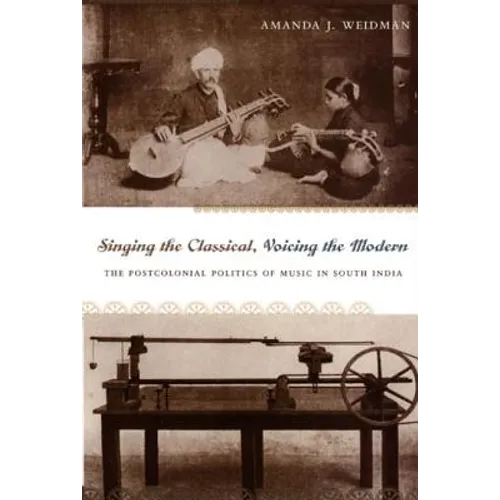
While Karnatic music, a form of Indian music based on the melodic principle of raga and time cycles called tala, is known today as South India's classical music, its status as "classical" is an early-twentieth-century construct, one that emerged in the crucible of colonial modernity, nationalist ideology, and South Indian regional politics. As Amanda J. Weidman demonstrates, in order for Karnatic music to be considered classical music, it needed to be modeled on Western classical music, with its system of notation, composers, compositions, conservatories, and concerts. At the same time, it needed to remain distinctively Indian. Weidman argues that these contradictory imperatives led to the emergence of a particular "politics of voice," in which the voice came to stand for authenticity and Indianness.
Combining ethnographic observation derived from her experience as a student and performer of South Indian music with close readings of archival materials, Weidman traces the emergence of this politics of voice through compelling analyses of the relationship between vocal sound and instrumental imitation, conventions of performance and staging, the status of women as performers, debates about language and music, and the relationship between oral tradition and technologies of printing and sound reproduction. Through her sustained exploration of the way "voice" is elaborated as a trope of modern subjectivity, national identity, and cultural authenticity, Weidman provides a model for thinking about the voice in anthropological and historical terms. In so doing, she shows that modernity is characterized as much by particular ideas about orality, aurality, and the voice as it is by regimes of visuality.
Back Jacket
Amanda J. Weidman brilliantly turns the tables on ideologies of voice in challenging us to envision music as constituting technologies for producing" voices. Ethnomusicology, anthropology, postcolonial studies, and critical histories of technology all take a step forward as a genealogy of Indian 'classical' music engenders new insights into colonialism, nationalism, gender, traditionality, and modernity."--Charles L. Briggs, Professor of Anthropology, University of California, Berkeley
Author Biography
Amanda J. Weidman is Assistant Professor of Anthropology at Bryn Mawr College.



