


Product Description
by Ashok Kumar (Author)
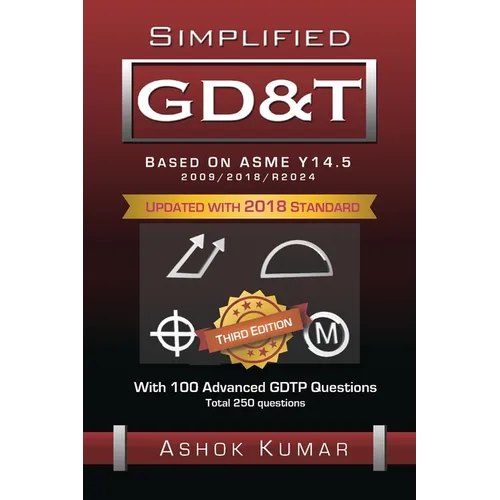
Dear Readers, Thanks for making it #1 Best seller on Amazon Thrilled by responses, driven by suggestions, here is second edition of the book to add: -Analysis of real life Industrial application collected from multiple MNCs-Question bank (100 fundamental based and 50 numerical based questions)-Editing based on feedback received, to bring more valuePurpose of the book: -This book is to take you through an exciting journey of learning new mechanical engineering language, namely, Geometric Dimensioning and Tolerancing (GD&T). It is a functional language to define and communicate geometric tolerances (allowable variations) applicable to geometries (also called features) of mechanical parts and assemblies. -The purpose of this book is to learn (read and write) this language.What can the reader hope to learn by reading the book?Starting the journey with the origin of GD&T, we will learn: -Fundamentals of dimensioning, tolerancing and dimensioning rules.-Fundamental concepts of hole and shaft basis systems, basic/nominal size, limit, tolerance, actual size, deviation, allowance, and related technical terms.-Understanding mechanical features, a feature of size (FOS) and feature material condition (MMC/LMC/RFS), Datum, Datum feature, Datum feature frame, the degree of freedom, datum target, and datum simulators.-Fourteen feature controls tolerances of GD&T (straightness, flatness, circularity, cylindricity, etc.), practical application of each tolerance, the impact of MMC/LMC, understanding bonus tolerance, and writing in feature control frame.-Advanced concepts of boundary and envelope, MMB, LMB, RFB, virtual condition, resultant condition, unrelated and related actual mating envelopes.-14 most frequently used modifiers, namely, translation, projected tolerance zone, free state, tangent plane, unequally disposed profile, independency, statistical tolerance, continuous feature, controlled radius, dimension origin, between, all around, all over, and individually.-Analysis of industrial application examples, to see how industry adapts and modify the standards in real life.-100 fundamental based and 50 numerical questions to test your learning..-Appendix section including the concept of ISO-286 and IT grades, industry best practices for dimensional tolerancingWhile covering more than core GD&T concepts, a couple of designing process have also been included to provide holistic knowledge for practical purposes.About the journey of writing this book: Being a mechanical engineer, it was exciting for me to find a new evolving language in the industry. To find out the ground reality of usage of GD&T, I visited industries and educational institutes, talked to professionals, teachers, and students. Almost everywhere, a sense of difficulty to understand the new concept was found. To understand the concepts of ASME Y14.5-2009, a need of a textbook was felt, which is easy to understand, which can be used for stepwise learning, having questions, exercises, etc. I started the endeavor to write this book by contacting many of my friends, friend's friends, to collaborate and find more information, samples, industrial applications, challenges, etc. I locally printed the first sample of the book, gave it to industrial designers, Design heads, Manufacturers, Head-of-departments and Principals of colleges, established famous Authors of mechanical engineering subjects, and other colleagues. Most of them liked the book's simplified approach to describe the complex subject matter and provided their feedbacks, which are incorporated in the book. Therefore, this book is not only the output of my efforts, rather it is a combined output of many elite people working in the area of GD&T for some time now. I wish my readers to take benefit of fundamental learning and real-life examples, and to be front line runner in this evolving area of the mechanical industry All the best Happy learning Ashok