Product Description
by Linda L. Metler (Author), Robert Jensen (Author), William a. Luke (Author)
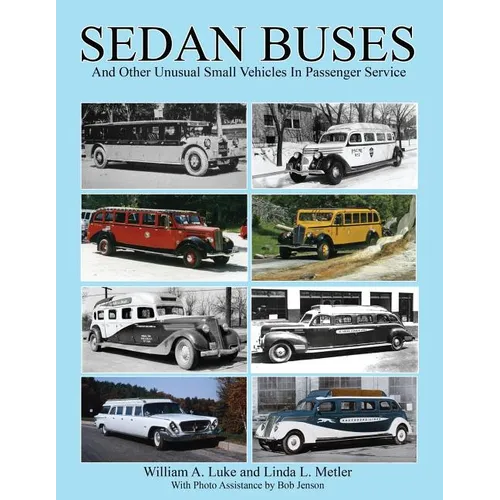
This book contains photos of dozens of sedan buses, van buses and other unusual vehicles. Beginning in the 1930s bus builders stretched regular sedans by adding rows of passenger seating. Early sedan buses had no front entrance door or center aisle. Passengers had to enter through doors at each seating row. One of the first manufacturers specializing only in sedan buses was the Armbruster Company. The Fitzjohn Body Company probably built the most stretched sedan buses. In 1936 Glacier National Park put 36 sightseeing buses ("The Little Reds") in service. Yellowstone National Park also had a fleet of the same White Model 706s. During World War II Fitzjohn built sedan buses to transport workers to and from defense plants. The first sedan buses in southern New England operated over short-line railroad routes. The success of the German Volkswagen bus in 1950 led to changes. Checker Motors Corporation built the Aerobus based on its Marathon station wagon. Even a few "truck buses" are pictured that had added passenger seating behind the driver. Greyhound Lines converted some of its Scenicruisers to passenger/package express vehicles.
Author Biography
William A "Bill" Luke began taking an interest in bus transportation during his grammar school years, observing the bus activity at the Greyhound bus station in Virginia, Minnesota. It was the Depression and Bill saved his newspaper delivery money to make bus trips. He also wrote to bus companies to obtain pictures, timetables, maps and other information about bus transportation. He served in the U.S. Army in Europe during World War II. Even while in Europe, he took every opportunity to observe the bus services that were in operation. Returning home he completed more education and continued his interest in bus transportation, collecting even more information. Bus transportation was an early career choice and after college he began work in Minneapolis with Jefferson Transportation Company. That opened up even greater interest in bus transportation, offering an opportunity to travel throughout the country and Canada on various intercity bus lines. He also rode city buses in any city where he stopped, even for a few hours. It was all a learning experience. Jefferson Lines had several sedan buses and he didn't neglect that aspect of bus transportation. He took many photographs of Jefferson's sedan buses and those of other companies he observed during his travels. Fortunately, this encouraged Bill to look for more pictures and information and now the history of the sedan bus is being preserved in this book. It appeared that the timing was right and Bus Ride grew as an important bus industry trade journal. As a result Bill left Empire Lines and began devoting full time to the publication business. A corporation was formed and named Friendship Publications. Adelene became the president of the corporation and Bill was the vice president and editor and publisher. In addition to publishing Bus Ride, which grew from four issues a year to ten, two directories were inaugurated, and a series of seminars were presented in cities in the United States, including Honolulu, Hawaii, and Anchorage, Alaska. A Canadian seminar was also held in a different city each year. The bus industry kept changing and Friendship Publications adapted. Foreign buses were being acquired in the United States and that encouraged foreign bus manufacturers to advertise in Bus Ride. It also resulted in considerable foreign travel for Bill and Adelene. Thus they developed strong friendships, not only in the United States and Canada but also throughout the world.