


Product Description
by Scott W. Smith (Author)
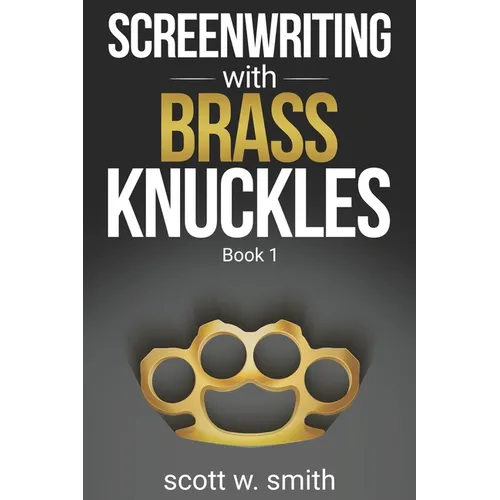
"If your journey is anything like ours, at some point you'll hit a wall. Festivals will reject your screenplay. Agencies will pass on representing you. Executives are going to tell you no. Then maybe one day, someone will say yes to your script." -Screenwriters Scott Beck and Bryan Woods, "A Quiet Place"(from the forward to "Screenwriting with Brass Knuckles")Every screenwriter faces fear and failure. The legendary screenwriter William Goldman once said he was "programed to fail." Yet he went on to have a long career that included winning two Oscar Awards. Susannah Grant put a positive spin on constant failure saying "that free-falling feeling you get right on the knife edge of total disaster may in fact be an essential ingredient to doing anything worthwhile." Arguably the worst failure for the new screenwriting is either not finishing a script -or not even starting the writing process. You'll find throughout this book that talent and hard work are essential to succeed at any level. You can't teach that. But distilled from over 3,000 posts from Emmy-winner Scott W. Smith's nationally recognized blog Screenwriting from Iowa . . .. and Other Unlikely Places, these 10 chapters will hopefully guide and inspire you to improve your writing and output. Sprinkled throughout these pages are quotes curated from an eclectic and diverse mix of many top screenwriters and filmmakers throughout the history of film and television.CONFLICT - Why is this a key foundational concept in all storytelling? It's one thing that movies, plays, television and streaming shows, documentaries, and dramatic podcasts all have in common.CONCEPT - Screenwriter Terry Rossio ("Shrek") believes new writers make one common mistake at the start.CHARACTERS - Why does David Mamet think Wile E. Coyote can be a good role model for your characters?CATALYST - How did screenwriters Debra Granik and Anne Rosellini grab audience's attention early in their movie "Winter's Bone?" No matter what genre you're writing (drama, comedy, horror, action, etc.) something disruptive must happen in the first act.CONSTRUCTION - Why Rian Johnson ("Knives Out") says structure seems antithetical to the free-wheeling creative process but is actually essential to understand.CLIMAXES/ CONCLUSIONS - What does "Toy Story 3" screenwriter Michael Arndt think makes the difference between a good, a bad, and an "insanely great" ending? CATHARSIS - Francis Marion, the first screenwriter to win two Academy Awards (and she wrote one of the first books on screenwriting back in 1937) understood that the goal of writing for film is to make a spectator feel. CONTROLLING IDEA - Perhaps no concept is more divisive that the idea of a theme. Find out how screenwriters Ryan Coogler, Rod Serling, Kelly Marcel, Francis Ford Coppola, and Wes Anderson differ on handling theme. CHANGE - Why is asking the question "What's changed?" so critical to every scene you write?CAREERS AND COWS - Aaron Sorkin, Diablo Cody, James Cameron, Callie Khouri, Barry Jenkins, LuLu Wang, and Alejandro G. I rritu all had day jobs (some "survival jobs") before they found filmmaking success. Where one artist found inspiration in an unusual place. And what's the one thing you can do to help get Shonda Rhimes to ask what your spec script is about?