Product Description
by Kimura Kenichi (Author)
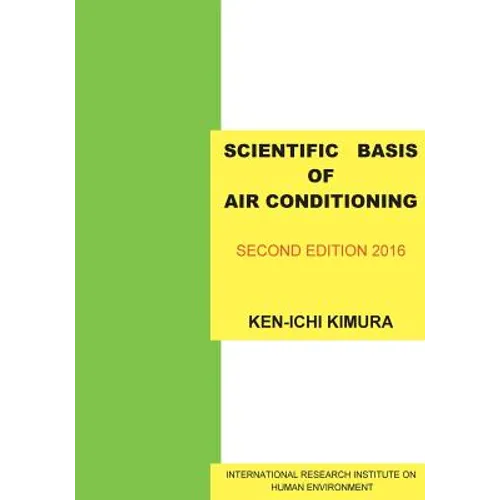
This book is written as an advanced text for graduate students in architectural science, building science, building engineering, architectural engineering and mechanical engineering, as well as a reference book for practising air conditioning engineers. It deals with the scientific nature of air conditioning, from the basic theories to the applied technology as it is generally accepted today. The purpose of air conditioning is to create comfortable conditions in the building environment. However, air conditioning ought to be blamed as it consumes an excessive amount of primary energy. It is therefore important to learn both the scientific basis of air conditioning and the principles of energy conservation to ensure that air conditioning is designed in the most efficient manner. The performance of air conditioning depends on various parameters and it is related to many different aspects of science. For example, solar radiation incident on building surfaces and transmitted through windows has an important influence on the thermal environment of the occupied space, while the basic theories of solar radiation belong to physics and environmental science. Heat transfer is taught in the departments of mechanical engineering and chemical engineering; however, unsteady-state condition and non-linear heat transfer occur everywhere in a building and heat transfer in buildings entails somewhat different features from those governing heat transfer in mechanical systems. Heat conduction within the building structure, heat convection along the interior and exterior surfaces of building components, and radiation exchange between the surfaces of enclosed spaces may sometimes give rise to quite complicated problems. In the past, teachers of air conditioning have had to collect the information applicable to air conditioning practice from different fields of science and no systematic theory seems to have been established in the realm of air conditioning. On the other hand, it is often claimed that architects do not understand environmental problems, such as air conditioning, and this is accounted for by the insufficient teaching of its scientific basis in architecture schools. Looking at all the scientific aspects of air conditioning, it is quite difficult to organise them into a systematically routine course. The contents of this book are mainly focused on the thermal behavior of the environmental space. The first six chapters describe the basis for the heat load estimation of air conditioning, which is summarised in Chapter 7. Chapters 8 and 9 deal with engineering features and review the basic theories to be applied to engineering practice. Part of this book is derived from a volume written by myself in Japanese entitled Fundamental Theories of Building Services, and I am obliged to the publisher for permission to reproduce these articles. The manuscript of this book is not a direct translation from the articles in Japanese and later developments in various research results are, of course, included. After visiting Japan in 1972, Professor Henry J. Cowan suggested that I should write this book. Professor Cowan and his colleagues, Professor P. Smith and Dr Valerie Havyatt, were kind enough to review the first draft of the manuscript and to correct the English to a considerable extent. I would like to express my sincere thanks to them. I feel much indebted to Professor U. Inoue, Department of Architecture, Waseda University, for his advice and encouragement in writing this book and to Dr. D. G. Stephenson and Mr. G. P. Mitalas, Division of Building Research, National Research Council of Canada, for their kind guidance in the study, on which a considerable portion of this book is based, undertaken during my stay in Ottawa from 1967 to 1969. Without their valuable help this publication would not have been possible.