


Product Description
by James Franklin (Author)
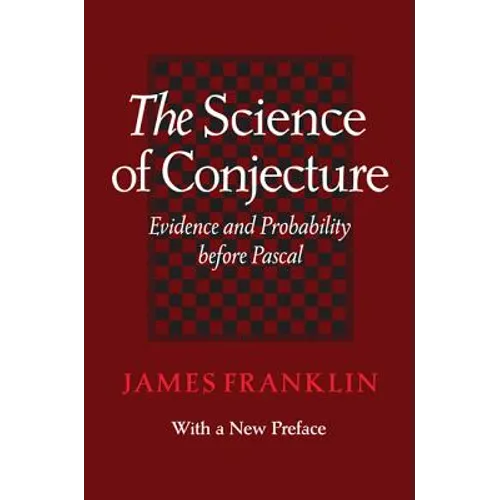
How did we make reliable predictions before Pascal and Fermat's discovery of the mathematics of probability in 1654? What methods in law, science, commerce, philosophy, and logic helped us to get at the truth in cases where certainty was not attainable? In The Science of Conjecture, James Franklin examines how judges, witch inquisitors, and juries evaluated evidence; how scientists weighed reasons for and against scientific theories; and how merchants counted shipwrecks to determine insurance rates.
The Science of Conjecture provides a history of rational methods of dealing with uncertainty and explores the coming to consciousness of the human understanding of risk.
Front Jacket
How did we make reliable predictions before Pascal and Fermat's discovery of the mathematics of probability in 1654? What methods in law, science, commerce, philosophy, and logic helped us to get at the truth in cases where certainty was not attainable? In The Science of Conjecture, James Franklin examines how judges, witch inquisitors, and juries evaluated evidence; how scientists weighed reasons for and against scientific theories; and how merchants counted shipwrecks to determine insurance rates.
The Science of Conjecture provides a history of rational methods of dealing with uncertainty and explores the coming to consciousness of the human understanding of risk.
A remarkable book. Mr. Franklin writes clearly and exhibits a wry wit. But he also ranges knowledgeably across many disciplines and over many centuries.--Wall Street Journal
The Science of Conjecture opens an old chest of human attempts to draw order from havoc and wipes clean the rust from some cast-off classical tools that can now be reused to help build a framework for the unpredictable future.--Science
Franklin's style is clear and fluent, with an occasional sly Gibbonian aside to make the reader chuckle.--New Criterion
James Franklin is a professor in the School of Mathematics and Statistics at the University of New South Wales.
--Stephen Stigler, University of Chicago, author of The History of Statistics: The Measurement of Uncertainty before 1900 "Wall Street Journal"Back Jacket
How did we make reliable predictions before Pascal and Fermat's discovery of the mathematics of probability in 1654? What methods in law, science, commerce, philosophy, and logic helped us to get at the truth in cases where certainty was not attainable? In The Science of Conjecture, James Franklin examines how judges, witch inquisitors, and juries evaluated evidence; how scientists weighed reasons for and against scientific theories; and how merchants counted shipwrecks to determine insurance rates.
The Science of Conjecture provides a history of rational methods of dealing with uncertainty and explores the coming to consciousness of the human understanding of risk.
"A remarkable book. Mr. Franklin writes clearly and exhibits a wry wit. But he also ranges knowledgeably across many disciplines and over many centuries."--Wall Street Journal
"The Science of Conjecture opens an old chest of human attempts to draw order from havoc and wipes clean the rust from some cast-off classical tools that can now be reused to help build a framework for the unpredictable future."--Science
"Franklin's style is clear and fluent, with an occasional sly Gibbonian aside to make the reader chuckle."--New Criterion
James Franklin is a professor in the School of Mathematics and Statistics at the University of New South Wales.
Author Biography
James Franklin is a professor in the School of Mathematics and Statistics at the University of New South Wales.