Product Description
by Mark Santow (Author)
A groundbreaking examination of Saul Alinsky's organizing work as it relates to race.
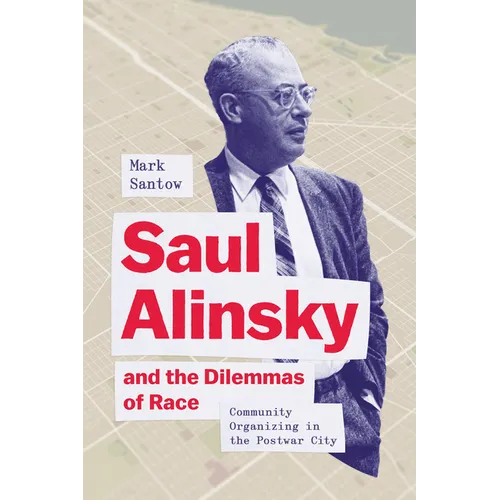
Saul Alinsky is the most famous--even infamous--community organizer in American history. Almost single-handedly, he invented a new political form: community federations, which used the power of a neighborhood's residents to define and fight for their own interests. Across a long and controversial career spanning more than three decades, Alinsky and his Industrial Areas Foundation organized Eastern European meatpackers in Chicago, Kansas City, Buffalo, and St. Paul; Mexican Americans in California and Arizona; white middle-class homeowners on the edge of Chicago's South Side black ghetto; and African Americans in Rochester, Buffalo, Chicago, and other cities. Mark Santow focuses on Alinsky's attempts to grapple with the biggest moral dilemma of his age: race. As Santow shows, Alinsky was one of the few activists of the period to take on issues of race on paper and in the streets, on both sides of the color line, in the halls of power, and at the grassroots, in Chicago and in Washington, DC. Alinsky's ideas, actions, and organizations thus provide us with a unique and comprehensive viewpoint on the politics of race, poverty, and social geography in the United States in the decades after World War II. Through Alinsky's organizing and writing, we can see how the metropolitan color line was constructed, contested, and maintained--on the street, at the national level, and among white and black alike. In doing so, Santow offers new insight into an epochal figure and the society he worked to change.Author Biography
Mark Santow is associate professor and chair of the History Department at the University of Massachusetts-Dartmouth. He is coauthor of Social Security and the Middle Class Squeeze.
Number of Pages: 400
Dimensions: 1.34 x 9.06 x 5.83 IN
Publication Date: September 15, 2023