


Product Description
by Douglas Aircraft (Author), NASA (Other)
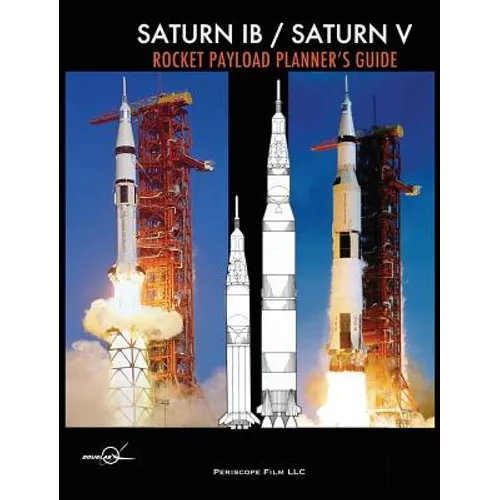
Developments of America's first heavy lift space rocket Saturn I, the Saturn IB and Saturn V propelled America's space program during the Apollo and Skylab eras. First launched in 1966, Saturn IB replaced the Saturn I's S-IV second stage with the more powerful S-IVB. It could carry a partially fueled Apollo Command / Service Module or fully fueled Lunar Module into low Earth orbit, allowing critical testing of these systems to be conducted long before the Saturn V was ready. It also flew one orbital mission without a payload, with the extra fuel used to demonstrate that the S-IVB's J-2 engine could be restarted in zero gravity - a critical operation for translunar injection. The Saturn IB produced thrust equivalent to 1.6 million pounds force, and could carry 46,000 pounds of payload to low Earth orbit. Saturn IB flew nine times, including three Skylab missions and for the Apollo-Soyuz Test Project. Saturn V was simply the heaviest, tallest, and most powerful rocket ever built, and capable of carrying the heaviest payload. First launched in 1967, the rocket consisted of three stages, with the S-IVB serving as its third stage. Taller than the Statue of Liberty, Saturn V had a mass of 3000 metric tons and five F-1 engines capable of producing thrust thrust of 7.6 million pounds-force. It could take payloads up to 100,000 pounds beyond Earth orbit or 262,000 pounds into low Earth orbit. It flew thirteen times, including eight times to the moon and (in a two-stage version) on the Skylab I mission. Originally prepared by the Missile and Space Systems Division of NASA contractor Douglas Aircraft, this book was created to acquaint payload planners with the capabilities of the Saturn IB and Saturn V rockets. It shows methods by which Saturn vehicles can accommodate payloads of various weights and volumes for different missions, and methods by which they might be modified to allow even greater performance. It's a wonderful reference for the museum docent, researcher, or anyone who ever wondered how these mighty rockets were designed and built.



