


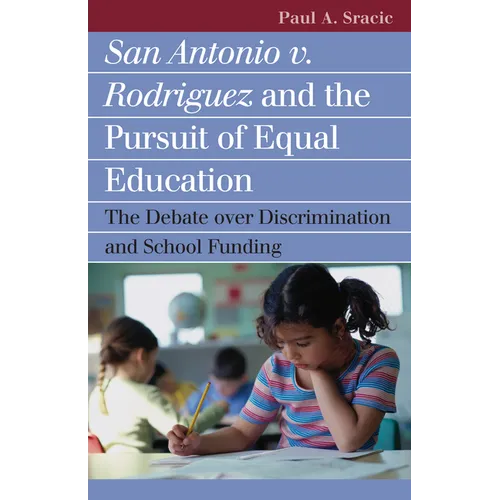
Product Description
by Paul A. Sracic (Author)
When Arthur Gochman filed a class-action suit in 1968 on behalf of San Antonio school children, he and his clients were directly challenging the inequality of education funding in Texas. They argued that quality education, not merely basic schooling, was a constitutional right, and a district court agreed. But the Supreme Court overruled that decision, signaling a halt to the idea that the Constitution contained a right to an equal education and marking an important transition from the Warren to the Burger Court.
Paul Sracic assesses the impact of this 5-4 decision to explore the legacy of a landmark case, telling the story of the Supreme Court and school finance in a new way. His is the first book to consider Rodriguez, tracing its progress from inception through appeal to provide a fascinating account of the legal maneuvering of the two sides-and a lesson in the limits of judicial solutions to discrimination in education. Balanced and judicious in his assessment, Sracic brings together the varied strands-oral history, litigation, constitutional law, political context-in this complex case, while clarifying the positions on both sides of the conflict. Justice Lewis Powell argued that education was not a constitutionally protected right and that the Equal Protection Clause does not require absolute equality or precisely equal advantages, while dissenting Justice Thurgood Marshall called the decision a retreat from America's commitment to equal opportunity that denigrated Brown v. Board of Education. Although Powell's and Marshall's opinions have been documented, until now little has been written about the history behind the case. Sracic puts a human face on the account. Among other things, he interviewed Demetrio Rodriguez, the parent whose name headlined the original suit, along with several students involved in the case. He also delved into Justice Powell's papers to show the influence of his prior experience championing local rather than state control over education and his fear of centralization's potential constraint on states' rights. In the wake of Rodriguez, the issue of school funding acquired a much higher national profile, even as efforts to reform it struggled towards varied degrees of success--in Texas and many other states. Sracic's very readable account unravels the complex legal doctrine links this vitally important case to the Fourteenth Amendment's guarantee of equal protection--and argues that one cannot fully grasp the scope of that amendment without fully understanding Rodriguez.
Number of Pages: 182
Dimensions: 0.52 x 8.54 x 5.56 IN
Publication Date: September 13, 2006



