


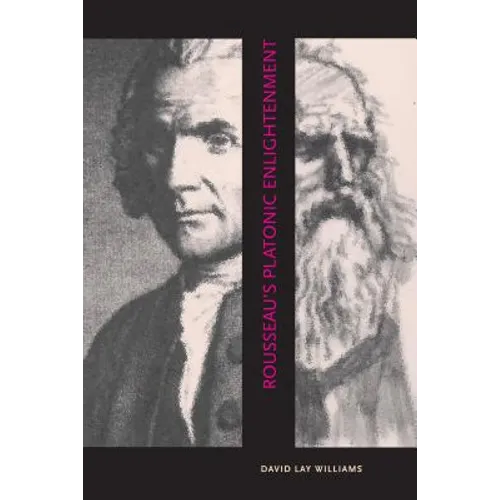
Product Description
by David Lay Williams (Author)
Although many commentators on Rousseau's philosophy have noted its affinities with Platonism and acknowledged the debt that Rousseau himself expressed to Plato on numerous occasions, David Williams is the first to offer a thoroughgoing, systematic examination of this linkage. His contributions to the scholarship on Rousseau in this book are threefold: he enters the debate over whether Rousseau is a Hobbesian (in rejecting transcendent norms) or a Platonist (in accepting them) with a decisive argument supporting the latter position; he tackles from a new angle the ever-challenging question of unity in Rousseau's thought; and he explores the dynamic metaphor of the chain throughout Rousseau's writings as a key to understanding them as inspired by Platonism.
The book is organized into three main parts. The first sketches the background of Platonism and materialist positivism in modern European metaphysics and political philosophy that provided the context for Rousseau's intellectual development. The second examines Rousseau's choice of Platonism over positivism and its consequences for his philosophy generally. The third addresses the legacy of Rousseau's thought and its appropriation by Kant, Marx, and Foucault, suggesting that in an age where materialism and relativism are rife, Rousseau may have much to teach us about how we view our own society and can engage in constructive critique of it.
Author Biography
David Lay Williams is Associate Professor of Political Science and Philosophy at the University of Wisconsin Stevens Point.
"