


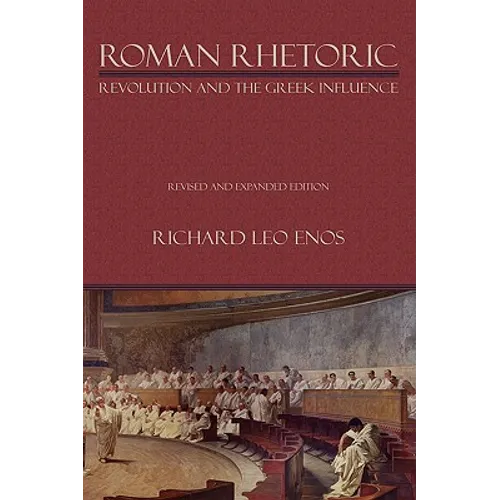
Product Description
by Richard Leo Enos (Author)
Greek and Roman traditions dominate classical rhetoric. Conventional historical accounts characterize Roman rhetoric as an appropriation and modification of Greek rhetoric, particularly the rhetoric that flourished in fifth and fourth centuries BCE Athens. However, the origins, nature and endurance of this Greco-Roman relationship have not been thoroughly explained. ROMAN RHETORIC: REVOLUTION AND THE GREEK INFLUENCE reveals that while Romans did benefit from Athenian rhetoric, their own rhetoric was also influenced by later Greek and non-Hellenic cultures, particularly the Etruscan civilization that held hegemony over all of Italy for hundreds of years before Rome came to power. Through the examination of archaeological, epigraphical, historical and literary evidence, ROMAN RHETORIC reveals that the relationship between Greek and Roman rhetoric was dynamic, evolving, and socially interactive. The long history of interaction between Greeks and Romans facilitated a cross-cultural rhetoric that evolved over time and was shaped by social and political forces. These forces often do not appear explicitly in rhetorical theory and practice, but they undeniably influenced classical rhetoric. ROMAN RHETORIC clarifies the relationships between Greek and Roman classical rhetoric by showing the historical forces that shaped their evolution as Romans conquered the Etruscans, as Greeks colonized areas of southern Italy that came to be called Magna Graecia, as Rome changed from Republic to Empire, and as the educational dominance of the Second Sophistic was challenged by efforts to create an emerging Christian rhetoric. RICHARD LEO ENOS is Professor and holder of the Lillian Radford Chair of Rhetoric and Composition at Texas Christian University. His research concentration is in classical rhetoric with an emphasis in the relationship between oral and written discourse. He is past president of the American Society for the History of Rhetoric (1980-1981) and the Rhetoric Society of America (1990-1991). He received the RSA George E. Yoos Award Distinguished Service and was inducted as an RSA Fellow in 2006. He is the founding editor of ADVANCES IN THE HISTORY OF RHETORIC and the editor (with David E. Beard) of ADVANCES IN THE HISTORY OF RHETORIC: THE FIRST SIX YEARS (2007, Parlor Press).



