


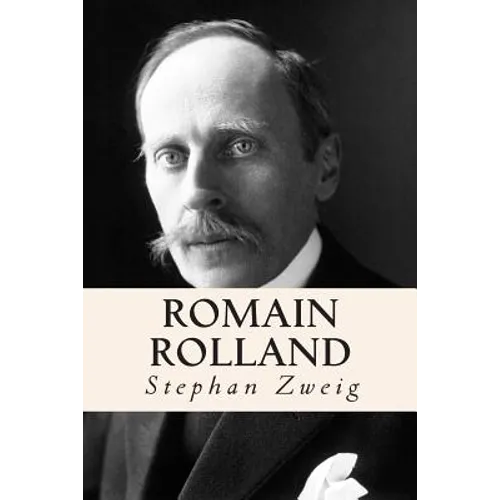
Product Description
by Stephan Zweig (Author)
Romain Rolland, by Stephan Zweig, is a classic literary biography of the great French dramatist, novelist, essayist, art historian and mystic. Romain Rolland (29 January 1866 - 30 December 1944) was a French dramatist, novelist, essayist, art historian and mystic who was awarded the Nobel Prize for Literature in 1915 "as a tribute to the lofty idealism of his literary production and to the sympathy and love of truth with which he has described different types of human beings". Rolland was born in Clamecy, Ni vre into a family that had both wealthy townspeople and farmers in its lineage. Writing introspectively in his Voyage int rieur (1942), he sees himself as a representative of an "antique species". He would cast these ancestors in Colas Breugnon (1919). Accepted to the cole normale sup rieure in 1886, he first studied philosophy, but his independence of spirit led him to abandon that so as not to submit to the dominant ideology. He received his degree in history in 1889 and spent two years in Rome, where his encounter with Malwida von Meysenbug-who had been a friend of Nietzsche and of Wagner-and his discovery of Italian masterpieces were decisive for the development of his thought. When he returned to France in 1895, he received his doctoral degree with his thesis Les origines du th tre lyrique moderne. Histoire de l'op ra en Europe avant Lulli et Scarlatti (The origins of modern lyric theatre. A History of Opera in Europe before Lully and Scarlatti). For the next two decades, he taught at various lyc es in Paris before directing the newly established music school cole des Hautes tudes Sociales from 1902-11. In 1903 he was appointed to the first chair of music history at the Sorbonne, he also directed briefly in 1911 the musical section at the French Institute in Florence. His first book was published in 1902, when he was 36 years old. Through his advocacy for a 'people's theatre', he made a significant contribution towards the democratization of the theatre. As a humanist, he embraced the work of the philosophers of India ("Conversations with Rabindranath Tagore" and Mohandas Gandhi). Romain Rolland was strongly influenced by the Vedanta philosophy of India, primarily through the works of Swami Vivekananda. A demanding, yet timid, young man, he did not like teaching. He was not indifferent to youth: Jean-Christophe, Olivier and their friends, the heroes of his novels, are young people. But with real-life persons, youths as well as adults, Romain Rolland maintained only a distant relationship. He was first and foremost a writer. Assured that literature would provide him with a modest income, he resigned from the university in 1912. Romain Rolland was a lifelong pacifist. He was one of the few major French writers to retain his pacifist internationalist values; he moved to Switzerland. He protested against the first World War in Au-dessus de la m l e (fr) (1915), Above the Battle (Chicago, 1916). In 1924, his book on Gandhi contributed to the Indian nonviolent leader's reputation and the two men met in 1931. In 1928 Romain Rolland and Hungarian scholar, philosopher and natural living experimenter Edmund Bordeaux Szekely founded the International Biogenic Society to promote and expand on their ideas of the integration of mind, body and spirit. In 1932 Rolland was among the first members of the World Committee Against War and Fascism, organized by Willi M nzenberg. Rolland criticized the control M nzenberg assumed over the committee and was against it being based in Berlin.
Author Biography
Stefan Zweig November 28, 1881 - February 22, 1942) was an Austrian novelist, playwright, journalist and biographer. At the height of his literary career, in the 1920s and 1930s, he was one of the most popular writers in the world.