


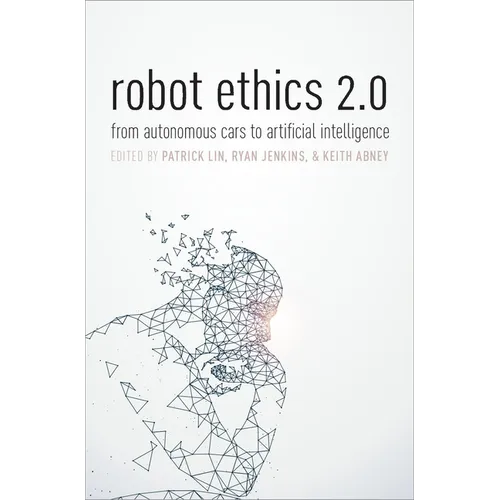
Product Description
by Patrick Lin (Editor), Keith Abney (Editor), Ryan Jenkins (Editor)
The robot population is rising on Earth and other planets. (Mars is inhabited entirely by robots.) As robots slip into more domains of human life--from the operating room to the bedroom--they take on our morally important tasks and decisions, as well as create new risks from psychological to physical. This makes it all the more urgent to study their ethical, legal, and policy impacts.
To help the robotics industry and broader society, we need to not only press ahead on a wide range of issues, but also identify new ones emerging as quickly as the field is evolving. For instance, where military robots had received much attention in the past (and are still controversial today), this volume looks toward autonomous cars here as an important case study that cuts across diverse issues, from liability to psychology to trust and more. And because robotics feeds into and is fed by AI, the Internet of Things, and other cognate fields, robot ethics must also reach into those domains, too. Expanding these discussions also means listening to new voices; robot ethics is no longer the concern of a handful of scholars. Experts from different academic disciplines and geographical areas are now playing vital roles in shaping ethical, legal, and policy discussions worldwide. So, for a more complete study, the editors of this volume look beyond the usual suspects for the latest thinking. Many of the views as represented in this cutting-edge volume are provocative--but also what we need to push forward in unfamiliar territory.Author Biography
Patrick Lin, Ph.D., is a philosophy professor and Director of the Ethics + Emerging Sciences Group at California Polytechnic State University. He is also affiliated with Stanford Law School, University of Notre Dame, and World Economic Forum; and previously with Stanford's School of Engineering, the U.S. Naval Academy, and Dartmouth College. On the ethics of emerging technologies, he has provided counsel to the U.S. Department of Defense, the United Nations, Google, Apple, and many other government and industry organizations.
Ryan Jenkins, Ph.D., is an assistant professor of philosophy and a Senior Fellow at the Ethics + Emerging Sciences Group at California Polytechnic State University. He focuses on normative ethics (especially consequentialism) and applied ethics, including military ethics and emerging technologies such as driverless cars, robots, and autonomous weapons. Keith Abney, A.B.D., is senior lecturer in the Philosophy Department and a Senior Fellow at the Ethics + Emerging Sciences Group at California Polytechnic State University, with research that includes work on demarcating science from non-science, moral status and sustainability, astronaut and space bioethics, patenting life, human enhancement, just war theory and the use of autonomous weapons, robot ethics, and other aspects of the ethical implications of emerging sciences and technologies