Product Description
by Sarah Winchell Lenhoff (Author), Jeremy Singer (Author)
A call for community-based approaches to reducing the barriers that prevent regular attendance in K-12 schools
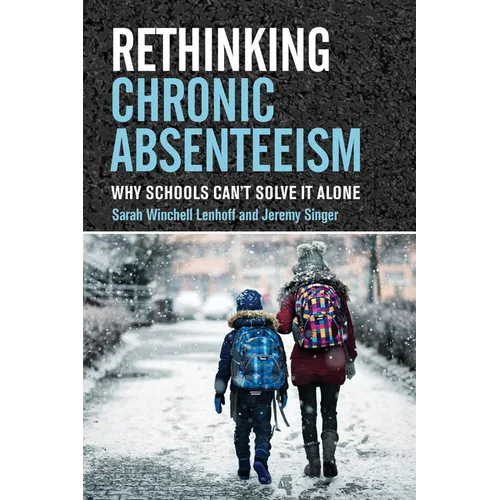
In Rethinking Chronic Absenteeism, Sarah Winchell Lenhoff and Jeremy Singer reframe chronic absenteeism as a symptom of a complex set of factors affecting the student, family, and community rather than simply an accountability metric for educators, schools, or districts. Lenhoff and Singer identify chronic absenteeism--often defined as missing 10 percent or more of instructional days--as an issue of social and economic inequality as much as an educational one, and they explore the role of K-12 schools and other organizations in solving this growing problem. The book is based on research conducted over eight years as part of a research-practice partnership with urban school systems in Detroit. Their results show the challenges of relying on school-based approaches to improve attendance, particularly in high absenteeism contexts where the causes of absenteeism are due to inequalities that are outside the scope of schools or districts to address. Lenhoff and Singer caution that school-based measures like punishments, parent fines, and even rewards can reinforce the social inequality that makes accessing school difficult. They stress that schools and districts should address factors within their purview: change the role of attendance-focused staff to act as navigators to help families remove barriers, improve school-home communication, help families access resources, and focus on building and sustaining positive relationships with students and families. The book also calls for broader societal change with recommendations for how policymakers, district and school leaders, and community partners can together adopt a more ecological approach to attendance.Author Biography
Sarah Winchell Lenhoff is the Leonard Kaplan Endowed Professor and associate professor of educational leadership and policy studies at Wayne State University. She is the director of the Detroit Partnership for Education Equity & Research (Detroit PEER). She began her career as a middle school teacher in New York City Public Schools and was previously the director of research and policy at the Education Trust-Midwest. Her research focuses on how education and other social policies shape access to educational opportunity. Jeremy Singer is a research assistant professor in educational leadership and policy studies at Wayne State University and the associate director of the Detroit Partnership for Education Equity & Research (Detroit PEER). He formerly taught in the Detroit Public Schools. His research focuses broadly on the intersections of educational policy and racial and socioeconomic inequality.