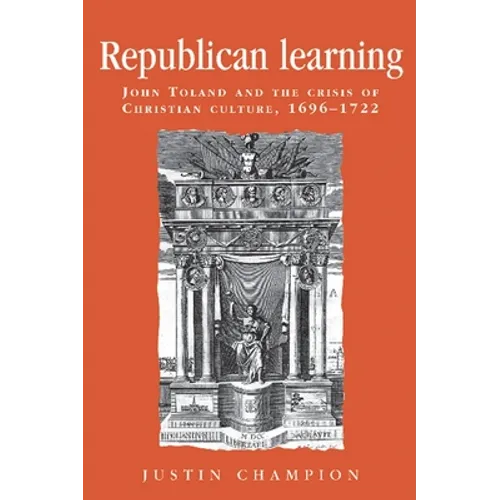
Product Description
by Justin Champion (Author)
This book explores the life, thought and political commitments of the free-thinker John Toland (1670-1722). Studying both his private archive and published works, it illustrates how Toland moved in both subversive and elite political circles in England and abroad. It explores the connections between his republican political thought and his irreligious belief about Christian doctrine, the ecclesiastical establishment and divine revelation, arguing that far from being a marginal and insignificant figure, Toland counted queens, princes and government ministers as his friends and political associates.
The book argues that Toland shaped the republican tradition after the Glorious Revolution into a practical and politically viable programme, focused not on destroying the monarchy, but on reforming public religion and the Church of England. It explores the connections between Toland's erudition and print culture, arguing that his intellectual project was aimed at compromising the authority of Christian 'knowledge' as much as the political power of the Church.Front Jacket
This book explores the life, thought and political commitments of the free-thinker John Toland (1670-1722). Studying both his private archive and published works, it illustrates how Toland moved in both subversive and elite political circles in England and abroad. It explores the connections between his republican political thought and his irreligious belief about Christian doctrine, the ecclesiastical establishment and divine revelation, arguing that far from being a marginal and insignificant figure, Toland counted queens, princes and government ministers as his friends and political associates. The book argues that Toland shaped the republican tradition after the Glorious Revolution into a practical and politically viable programme, focused not on destroying the monarchy, but on reforming public religion and the Church of England. It explores the connections between Toland's erudition and print culture, arguing that his intellectual project was aimed at compromising the authority of Christian 'knowledge' as much as the political power of the Church.
Back Jacket
This book explores the life, thought and political commitments of the free-thinker John Toland (1670-1722). Studying both his private archive and published works, it illustrates how Toland moved in both subversive and elite political circles in England and abroad. It explores the connections between his republican political thought and his irreligious belief about Christian doctrine, the ecclesiastical establishment and divine revelation, arguing that far from being a marginal and insignificant figure, Toland counted queens, princes and government ministers as his friends and political associates.
The book argues that Toland shaped the republican tradition after the Glorious Revolution into a practical and politically viable programme, focused not on destroying the monarchy, but on reforming public religion and the Church of England. It explores the connections between Toland's erudition and print culture, arguing that his intellectual project was aimed at compromising the authority of Christian 'knowledge' as much as the political power of the Church.Author Biography
Justin Champion is Professor of History at Royal Holloway, University of London