Skip to content
Welcome To Our Store.
100,000+ Products for Home, Medical, Office & Classroom Needs
Search
Skip to product information
1 of 1

Representing Justice: Invention, Controversy, and Rights In City-States and Democratic Courtrooms - Hardcover

$122.02 USD
$122.02 USD
Sale Sold out
Shipping calculated at checkout.
In stock (100 units), ready to be shipped

Available Offers

Fastest Delivery Tomorrow With Vip DealOrder within 1 hr 8 mins.

Instant 10% Discount On HDFC Banks Credit/Debit Cards EMI and CreditCard

Secure checkout with
  • American Express
  • Apple Pay
  • Diners Club
  • Discover
  • Google Pay
  • Mastercard
  • PayPal
  • Shop Pay
  • Visa

Flight Range: Up to 1,000 meters (3,280 feet)

Maximum Speed: 45 kilometers per hour (28 miles per hour)

For all orders exceeding a value of 100USD shipping is offered for free.

Returns will be accepted for up to 10 days of Customer’s receipt or tracking number on unworn items. You, as a Customer, are obliged to inform us via email before you return the item.

Otherwise, standard shipping charges apply. Check out our delivery Terms & Conditions for more details.

View Product Details
Shopping cart
Product Product subtotal Quantity Price Product subtotal
Representing Justice: Invention, Controversy, and Rights In City-States and Democratic Courtrooms - Hardcover
$122.02/ea
$0.00
$122.02/ea $0.00

Product Description

by Judith Resnik (Author), Dennis Curtis (Author)

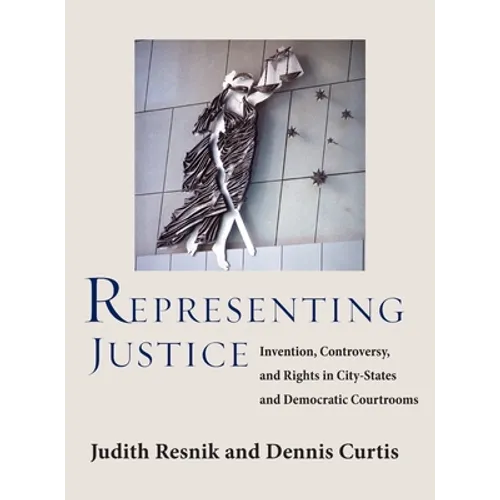
The relationship between courts and democracy is the central question of this book. The authors explore the evolution of adjudication into its modern form by mapping the remarkable run of the political icon of Justice and by tracing the development of public spaces dedicated to justice-courthouses.

Resnik and Curtis analyze how Renaissance "rites" of judgment turned into democratic "rights," requiring governments to protect judicial independence and to provide open and public hearings. Courts developed, alongside the press and the postal services, as mechanisms for building the public sphere and for calling the government to account. During the twentieth century, all persons gained access to rights of fair treatment in courts.

Today, however, private processes are replacing public ones, as public and private sectors promote settlement, devolve decision-making to agencies, and outsource judgments to arbitrators and mediators. Often clad in glass to mark justice's transparency, new courthouse designs celebrate adjudication without reflecting on the problems of access, injustice, opacity, and the complexity of rendering impartial judgments.

With more than 220 images, readers can see both the longevity of aspirations for the Virtue Justice and the transformation of courts, as well as understand that, while venerable, courts are also vulnerable institutions that ought (like the post and the press) not be taken for granted. The argument is that the movement away from public adjudication is a problem for democracies because adjudication has important contributions to make to democracy.


Number of Pages: 722
Dimensions: 2.13 x 11 x 8.5 IN
Publication Date: June 01, 2022
you might like
