


Product Description
by Gerrit De Geest (Author)
A surprising new explanation for the radical growth of income inequality--and a new strategy for stopping it.
Income inequality has risen dramatically since the 1970s. But why, exactly? In Rents, Gerrit De Geest argues that the main cause is advances in marketing. Marketers have become better at causing and exploiting market distortions in legal ways. The legal system tries to prevent the deliberate creation of market failures, but it has not evolved at the same speed. Business schools have outsmarted law schools.
Over the time span 1970-2015, the impact of marketing on the economy has steadily increased, transforming competitive markets in less competitive ones by making prices less transparent, splitting informed and uninformed consumers, making products incomparable, locking in consumers, or exploiting psychological biases. This has increased the amount of artificial profits in the economy--called "rents" in economic jargon.
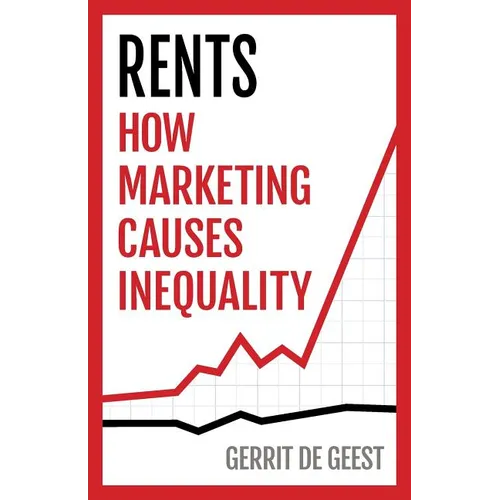
The result? Using a novel method, De Geest estimates that rents now amount to 35 percent of the economy. This means that out of every $100 you spend, on average $35 goes to profits that could not have been made in perfectly competitive markets. That was only $20 in 1970. The book shows how getting wealthy has become less a matter of working hard than of capturing rents.
A book that will explain both why your boss makes many times your salary and why the prices you pay for groceries keep changing.
"If you have a favorite brand of cars, airlines, aspirins, or smart-phones, then you are part of the problem of income inequality. This is the startling message of Gerrit De Geest's remarkable book. It will change your view of consumerism, the source of wealth, and the uneasy role of business schools in the modern economy. It is a book that will also make you a more interesting dinner companion "--Saul Levmore, William B. Graham Distinguished Service Professor, University of Chicago Law School
"This is one of those rare books that fundamentally change the way you look at the world. Marketing professors, De Geest argues, teach businesses how to exploit consumers. As a result, you pay too much for virtually every product and service you purchase. Once the book makes you see the problem, you cannot unsee it, and it is everywhere A provocative new theory of what goes wrong in the modern economy and why some people make so much more money than others."--Giuseppe Dari Mattiacci, Professor of Law and of Economics, University of Amsterdam
"Could the rising inequality in our society be the result of clever marketing ploys taught in business schools? Gerrit De Geest has written an original and powerful work on how so much creative and entrepreneurial effort is aimed at destroying the forces of competition, raising prices, and diverting value from people to firms. A law professor's indictment of the law's ineptitude in defending against greed, Rents sheds important new light on one of the biggest policy challenges of our time."--Omri Ben-Shahar, Kearney Director of the Coase-Sandor Institute for Law and Economics, University of Chicago
"In this captivating book, Professor De Geest highlights the underappreciated link between marketing and inequality. ... Novel and important, I highly recommend this book."--Oren Bar-Gill, W.J. Friedman and A.T. Friedman Professor of Law and Economics, Harvard Law School
Gerrit De Geest is the Charles F. Nagel Professor of International and Comparative Law at Washington University School of Law. Before moving to St. Louis with his family, he was a professor at the Utrecht School of Economics and president of the European Association of Law and Economics.