Product Description
by Philip J. Regal (Author)
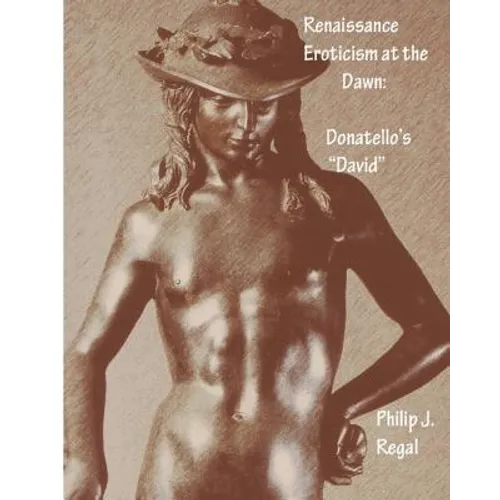
Nudity in religious art had been virtually all shameful for the first 1400 years of Christianity-sinners burning in Hell, Adam and Eve after The Fall. But in the early Italian Renaissance, the nude human body can be found with dignity and beauty even in religious art. How were centuries of religious beliefs and traditions overcome? Renaissance Eroticism at the Dawn explores this question. It focuses on a detailed study of the first freestanding nude statue since antiquity, Donatello's puzzling bronze "David." In the popular mind this statue has long been simply the Biblical David standing on the head of Goliath, but experts have found it to be in fact quite mysterious in its details and it has never made sense simply as the slaying of Goliath. It is argued here however that mysterious details of the statue do make good sense in a historical intellectual context that has now become better understood. The general context was an effort in Italian Christian intellectual circles (loosely, the Humanist Zeitgeist) to recover a pure spirituality, unadulterated by the dogmas and politics of the then oppressive Roman Church. Intellectual Christians scoured ancient philosophical, magical, and mythological texts for possible insights into universal and authentic spiritual truths that they felt had been suppressed and denied them by theocrats. Northern European Protestants had much the same complaints with Roman dogma but took their resentments in very different directions with the Reformation. Renaissance Eroticism at the Dawn examines the details of "David" in the context of modern readings of spiritual trends in 15th century Neo-Platonism, Hermeticism, Kabbalah, spiritual alchemy, mythological allegory, magic, and numerology. These were once dismissed as "esoteric" or "occult," superstitious beliefs. But scholars began to study them more seriously in recent decades-for example to better understand the roots of modern CONCEPTUAL science. These have now come to be regarded as important "proto-sciences" and "alternative spiritualities." Of course Renaissance spirituality also forms an important chapter not only for the history of science but also for the complex history of Christian thought and of the Reformation and Counter-Reformation-and indeed for the development of the modern mind. The deeper motivational question looms: What strong compulsions-what powerful human aspirations-could have led bright people to persist doggedly at such efforts, that from our contemporary perspective can seem nonsensical? A consideration of the potential "esoteric" spirituality in "David" is an opportunity to explore the personal and emotional dimensions of that remarkably rich, diverse, and historically transformative climate of questioning, investigation, and speculation in Renaissance Italy. Renaissance, Eros, Plato, Neo-Platonism, Donatello, occult, esoteric, alchemy, magic, Ficino, Florence, putti, Amor-Atys, nudity, baptism, Pagan, Christianity, history of science, sensuality, Pico de Mirandola, mythology, Reformation, Council of Trent, Council of Florence, Dante, homosexual, androgyny.
Author Biography
Philip J. Regal is Professor Emeritus, Biological Sciences, University of Minnesota. He also taught for many years in Cultural Studies and Comparative Literature. He is the Author of The Anatomy of Judgment, University of Minnesota Press, 1990.